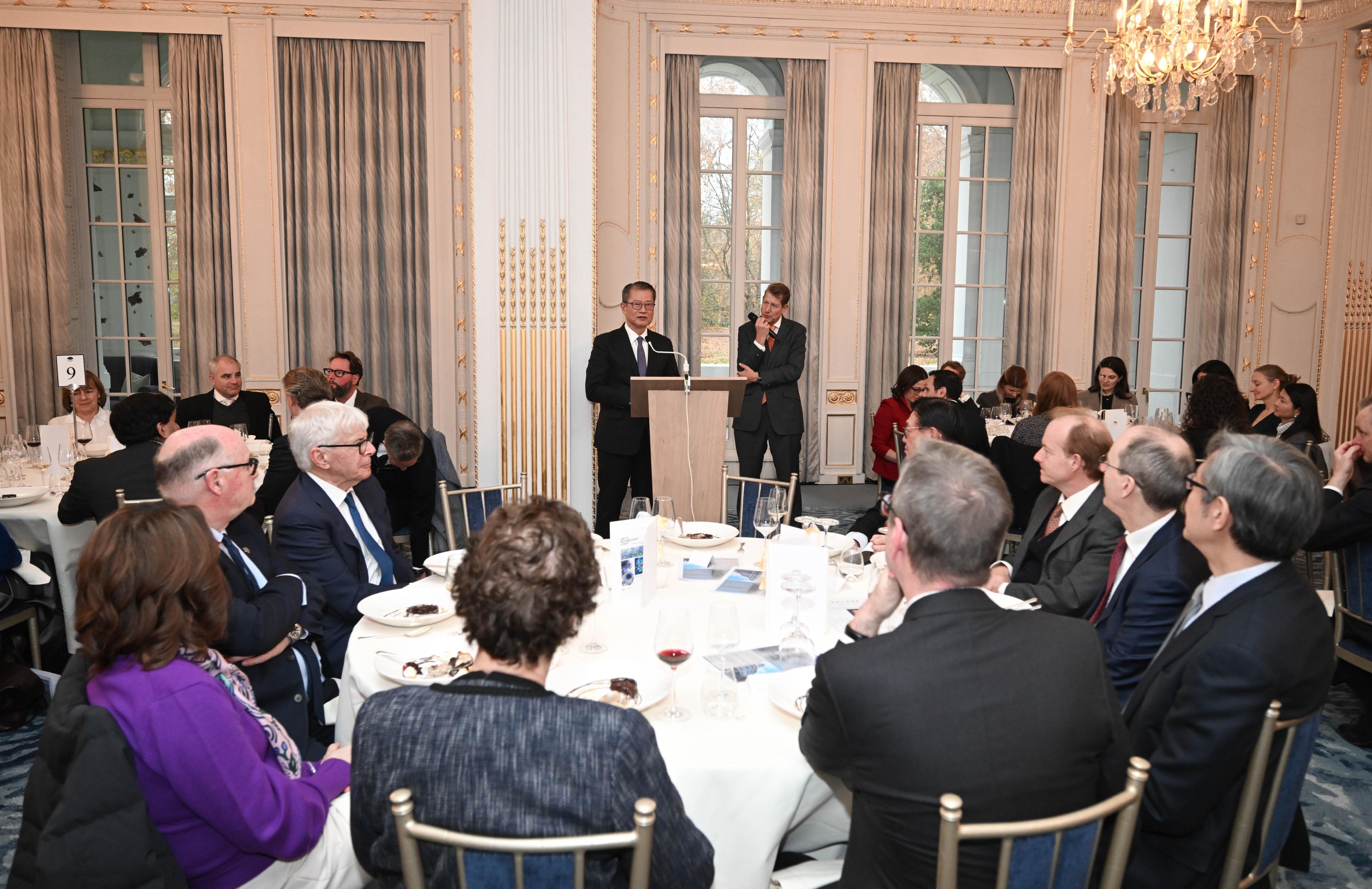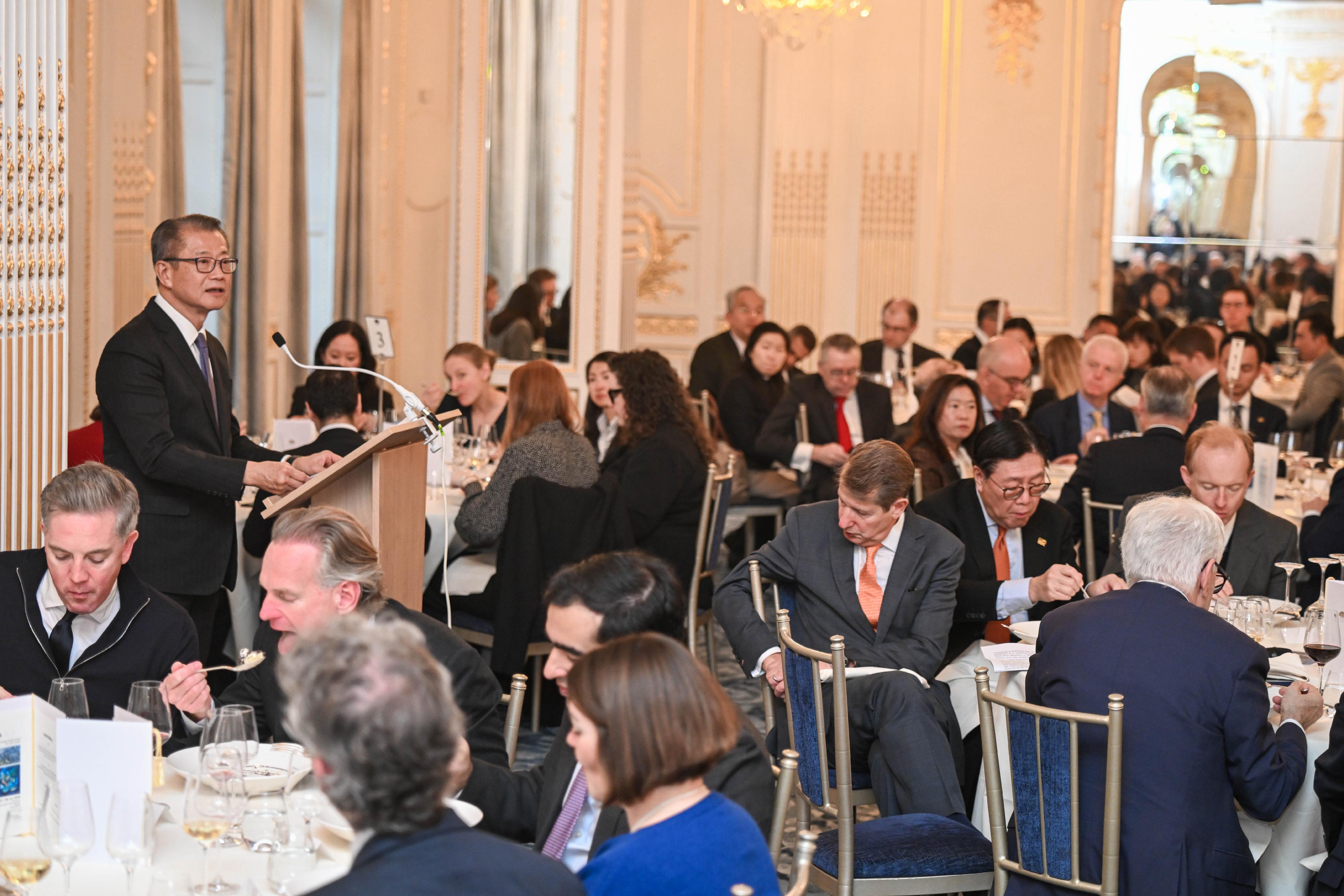

Speech by FS at Hong Kong Association Luncheon (English only) (with photos/video)
*********************************************************************************
Adrian (Chairman of the Hong Kong Association, Mr Adrian Cartwright), members of the Hong Kong Association, ladies and gentlemen, friends of Hong Kong all,
Good afternoon.
It is a pleasure to join you, once again, over a good London lunch and thank you for the welcome opportunity to talk about Hong Kong, my favourite luncheon subject.
Some of you will be attending this evening's Hong Kong Dinner. That tells me you also have a healthy appetite for Hong Kong. Tonight I will speak about our economy and how Hong Kong is doing overall. This afternoon, allow me to focus on innovation, on what Hong Kong and Britain together can create.
I have just spent a day in Cambridge with founders, investors and those who run business incubators. It was there, in 1953, over lunch at a pub called the Eagle, that Francis Crick announced that he and James Watson had found the secret of life - the double helix structure of DNA.
My luncheon ambitions are more modest, beginning with what is happening in the Chinese Mainland.
For many years, the world knew China for what it could manufacture. Today, the world is coming to know China for what it can invent. In March, our country adopted its 15th Five-Year Plan. Among its foremost objectives are to build a modern industrial system and to achieve greater self-reliance in science and technology.
Two fields illustrate the progress China is making.
One is artificial intelligence. According to this year's AI Index from Stanford University, the gap between the best American and the best Chinese models has effectively closed.
Last month in Beijing, I visited Moonshot AI, the company behind the Kimi models. It is not yet four years old and it works out of an unassuming commercial building, yet investors reportedly value it at around US$50 billion.
What impressed me most, however, were the people. Young and technically exceptional, they were already thinking about what next to build. China today is full of such entrepreneurs.
The other field is medicine, and China has become an internationally important source of new treatments. Last year alone, Chinese companies signed more than 150 agreements to license new medicines to international partners, in deals worth over US$130 billion.
The flow runs both ways. As Chinese living standards rise and people live longer, they are looking for higher quality products and better healthcare. For British researchers and companies in those fields, that opens up Mainland opportunities.
This is where Hong Kong comes in. As a "super connector", we can help a British company bring its technology to the Mainland. We can also help a Mainland company find the right partner in Britain.
A good connector does more than making the introduction. In Hong Kong, British partners can also raise capital, conduct research and put new technology to the test. That makes Hong Kong a "super value-adder" as well.
We are also building an innovation ecosystem of our own, enabling Hong Kong to become a source of new technologies.
In September, we published Hong Kong's First Five-Year Plan, setting out our strategic priorities and policies through to 2030. It describes our future in terms of "four centres and one hub". Three of the centres you know well: finance, trade, maritime and aviation. The hub is all about talent, while the fourth centre, innovation and technology, is at the heart of the Plan.
Innovation demands capital, and capital is something Hong Kong knows a good deal about. Our Finance+ strategy uses the strengths of our financial markets to drive growth in other sectors, with innovation foremost among them.
That creates a complete fund-raising chain, able to finance a technology company at every stage, from its first investor to its listing.
The chain begins with private capital. In its early years, a company can turn to private equity and venture capital funds, which manage about US$250 billion in Hong Kong. It can also look to the Hong Kong Investment Corporation, our patient capital arm, which has already backed more than 250 projects.
The chain continues on our stock exchange, which offers listing prospects even before a company turns a profit. In the first ten months of this year, 121 companies listed in Hong Kong, raising some 40 billion pounds. That's about 40 per cent more than the whole of last year, with two months still to be counted.
Capital, however, is only the beginning. Let's look now at what Hong Kong can offer as a centre for innovation.
In artificial intelligence, our capabilities lie in both research and application. Three of our universities rank among the world's top 30 for AI and data science. And in Hong Kong, data from the Mainland and the rest of the world come together.
Let me give you two examples of how far we have come. In 2019, a professor at one of our universities founded a firm called Smartmore to build AI systems that help factories inspect their products and run their production lines. Within 18 months, it was a unicorn.
In medicine, researchers at a company listed in Hong Kong, Insilico Medicine, used generative AI first to identify a new target for treating a serious lung disease, then to design a drug to act on it. This summer, that drug entered final-stage clinical trials.
We are determined to build on these strengths. Our strategy is AI+. It means developing AI as an industry and, at the same time, bringing it into every part of our economy, from finance and logistics to healthcare and education.
Promising technologies need to be commercialised and scaled. That's where our partnership with the rest of the Greater Bay Area is particularly valuable.
The Greater Bay Area counts 88 million people and an economy of more than US$2 trillion, with a GDP (Gross Domestic Product) per capita of more than US$25,000. It is also a major centre of advanced manufacturing. For a new technology, that means a testing ground, a production base and a large market, and all on our doorstep.
Nowhere is that partnership closer than at Hetao, known as the Loop. There, a science park in Hong Kong and its sister park in Shenzhen work hand in hand across the Shenzhen River. Researchers, materials, capital and data will soon move more easily between the two parks.
A pilot scheme for the flow of data across the boundary will begin this year. By the middle of next year, registered researchers will also be able to move conveniently between the two parks.
In medicine, the prospects for collaboration are particularly promising. The two parks are working together on clinical trials, enabling data and biological samples to be used on both sides of the boundary.
The national medicine regulator has a centre in the Shenzhen Park to evaluate medicines and medical devices. Hong Kong is establishing its own Centre for Medical Products Regulation, allowing a company to apply to both authorities at the same time. These arrangements should shorten the journey of a new medicine from laboratory to market.
The Loop is only one part of a much larger undertaking. The Northern Metropolis runs along our boundary with Shenzhen, covering about a third of Hong Kong's land area. It's designed to integrate research, education, talent and industry. To that end, three university towns are taking shape, with technology, industry and community areas around them.
To smooth the way, our legislature this month passed a law streamlining planning and land procedures there, allowing projects to proceed more quickly.
The way we allocate land is also changing. We will look beyond the highest bid, asking what technology a company will bring, what jobs it will create, what talent it will attract.
For enterprises of strategic value, we can put together a package consisting of land, financial support and tax concessions. Under proposed legislation, qualifying enterprises could pay profits tax at a rate as low as five per cent.
What does this mean for our British partners? For you? I see four areas of opportunity.
Beginning with universities. There is scope for joint laboratories, and for British universities to establish campuses of their own in the Northern Metropolis. Three campus sites in one of our university towns are now open for application. Some British universities have had more than 800 years to become what they are today. Our timetable is rather shorter, which is one more reason why we welcome their help.
The second opportunity is for British companies seeking a base in Asia. A life sciences company, for example, could establish a research team in the Loop and conduct clinical trials across the boundary, using Hong Kong to reach markets in the Mainland and elsewhere in Asia.
Some have already begun. AstraZeneca, which opened a research centre in Hong Kong in 2023, has since taken space at our park in the Loop, and GSK joined as a strategic enterprise last year.
There is room for younger companies, too. Hong Kong today has over 5 200 start-ups, more than three times as many as 10 years ago. A third of their founders are from outside Hong Kong. After the Mainland, the largest group is from Britain. I welcome more to join them.
The third opportunity is for British firms that can help Mainland companies enter new markets. Many Mainland technology companies are now expanding overseas, using Hong Kong as their base. A company bringing a product to Britain for the first time needs to know how to certify it and who is likely to buy it. A British firm with the answers could be a valuable partner.
Investing together is the fourth opportunity. The Hong Kong Investment Corporation welcomes British funds, university endowments and corporate investors as co-investors.
And here the Association can help. You may know a British spin-off seeking a manufacturer in Asia, or a Hong Kong or Mainland company looking for its first British customer. If you do, I hope you will bring them together. A partnership often begins with an introduction from a trusted friend.
I hope, too, that you will see the Northern Metropolis for yourselves. Our park in the Loop is already open, with more than 100 companies and institutions having moved in. Much of the rest is still to be built, which is the best reason to come now, while you can still help shape it.
Ladies and gentlemen, this Association (Hong Kong Association) traces its roots back to 1889. You know better than most how much Hong Kong and Britain have built together. Over the next five years, British and Hong Kong businesses will have new opportunities to invest together in promising technologies, bring new products to market and reach customers across Asia. We look forward to working with you to make the most of those opportunities.
Thank you.
I look forward to your questions.
Ends/Tuesday, November 24, 2026
Issued at HKT 21:40
NNNN