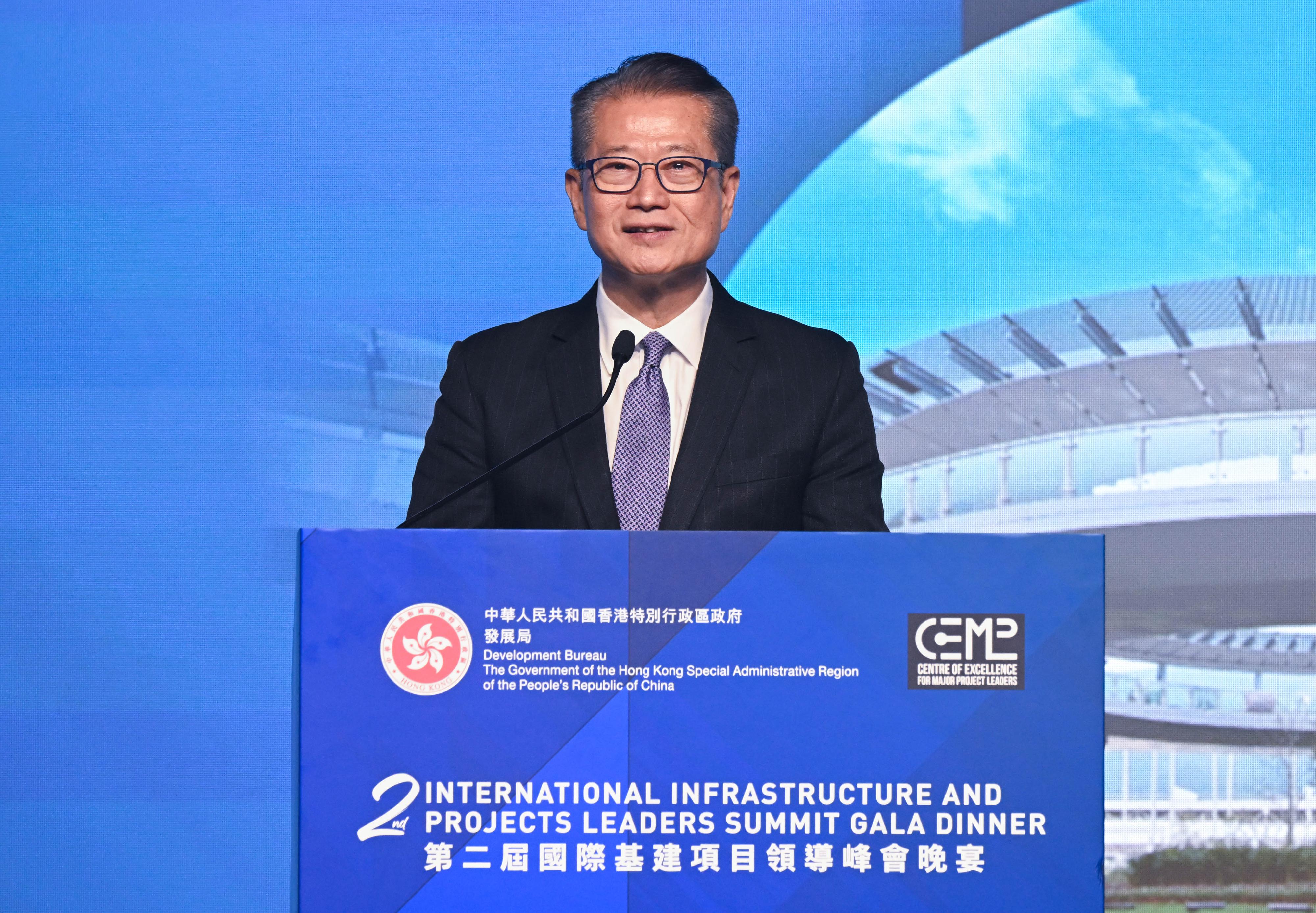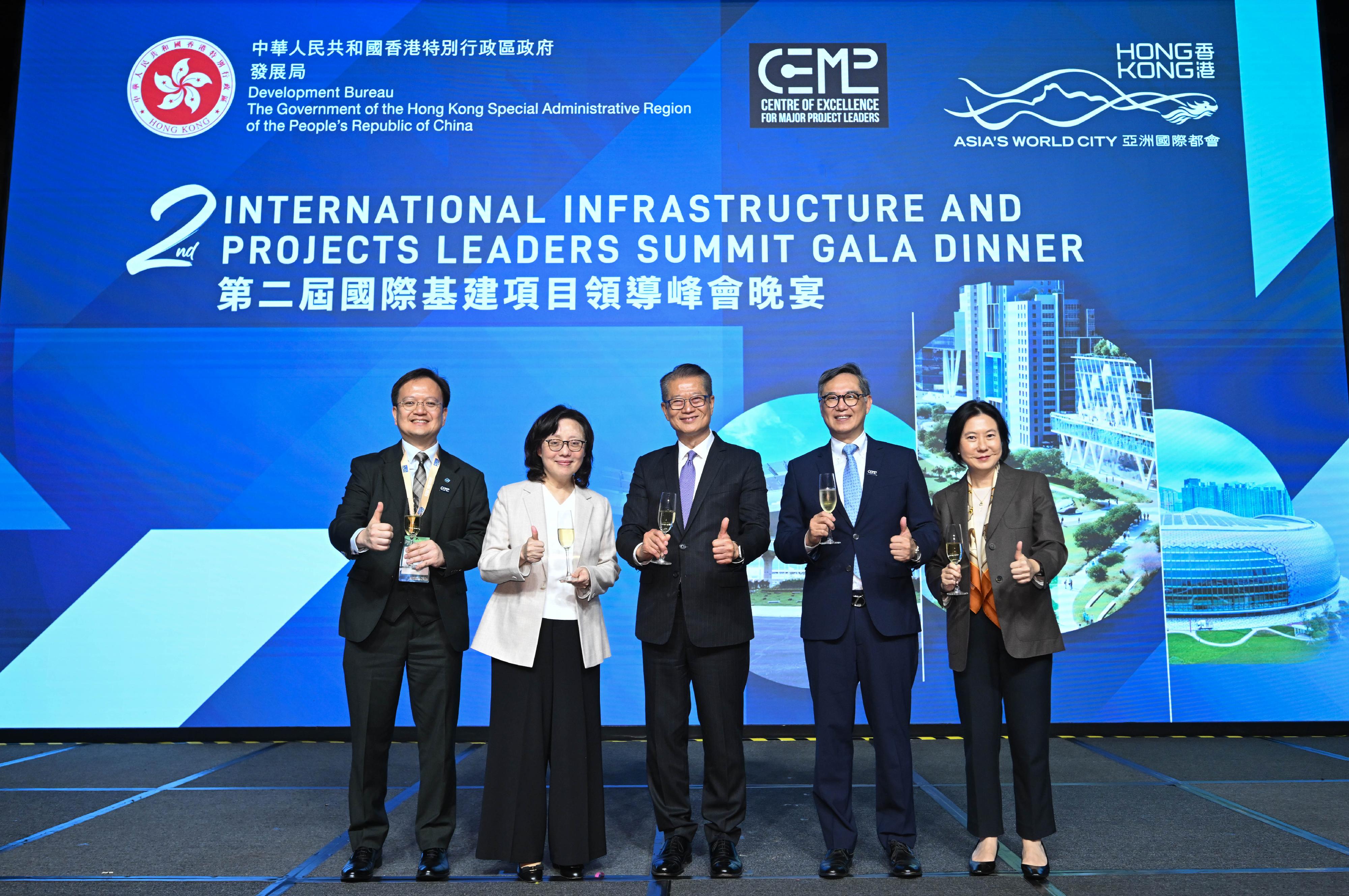

Speech by FS at 2nd International Infrastructure and Projects Leaders Summit Gala Dinner and Centre of Excellence Awards Presentation Ceremony (English only) (with photos)
******************************************************************************************
尊敬的劉部長 (Vice Minister of Water Resources of the People's Republic of China, Mr Liu Dongshun), Bernadette (Secretary for Development, Ms Bernadette Linn), distinguished guests, ladies and gentlemen,
Good evening. It is a great pleasure to join you tonight. To our friends who have come from more than 30 economies, a very warm welcome to Hong Kong. I wish you all a most enjoyable evening, and our visitors a rewarding stay in Hong Kong. Thank you.
I must admit that tonight's programme suits me well. Nothing makes a Financial Secretary happier than honouring people who have spent public money with care.
The theme of this Summit is "From Insights to Impacts". With infrastructure, impact takes time to show. It is not measured on the day the ribbon is cut. It is measured decades later, when the railway still runs on time, when the tunnel is still safe, and when a new town has grown into a community.
In that sense, every project is a promise that one generation makes to the next. Keeping that promise sets us two tests. One is commitment: the resolve to keep investing, and the means to pay for it. The other is value: making sure that every dollar is well spent, and that what we build is built to last.
Both matter far beyond Hong Kong. So let me start with the wider picture, and with the first test: commitment.
Across Asia and the Global South, the resolve is not in doubt. The means are harder to find. Ten days ago, the Asian Development Bank estimated that Southeast Asia alone needs US$ 7.1 trillion of infrastructure investment between now and 2040. At current levels of spending, governments can pay for less than half of that. The rest has to come from elsewhere. At the same time, long-term investors are looking for stable returns.
An international financial centre can bring the two together.
It starts with the basics. Companies that build and run infrastructure can raise capital by listing here. In the first ten months of this year, new listings in Hong Kong raised more than HKD 400 billion, the second-highest amount in the world. They can also borrow by issuing bonds. More of Asia's international bonds are arranged in Hong Kong than anywhere else, and that includes about 40 per cent of the region's green and sustainable bonds.
Then there are more innovative tools. One is to turn infrastructure loans into securities that investors can buy. Last month, the Hong Kong Mortgage Corporation completed its fourth issue of infrastructure loan-backed securities. Behind them are loans to 32 projects in 15 countries.
But funding is only half the story. There is also a shortage of well-prepared projects as a major obstacle to private investment. That brings me to the second test: value. A project has to be carefully planned and tightly run, with its risks clearly understood.
Hong Kong can help on all three. We have spent decades building and running railways, tunnels, bridges and an airport in one of the densest cities in the world. Our engineers, surveyors and operators know how to see a difficult project through, and they work closely with Mainland partners who bring advanced construction technology. We are happy to share what we have learned, including what we learned the hard way.
Then there is risk. Hong Kong has a deep insurance market, with around 160 authorised insurers, among them six of the world's ten largest. They can cover a major project from construction through to operation. And where a risk is too large for insurers alone, the capital markets can share it. The World Bank has issued catastrophe bonds here for Chile and Jamaica. When a hurricane struck Jamaica last year, the bond paid out in full, and the money helped to restore the power network.
And when disputes arise, as disputes will, they can be settled here. Just recently, a dispute over an infrastructure project in Malaysia was resolved at the International Organization for Mediation, which is headquartered in this city.
Capital, know-how and a steady hand on risk. None of these is unique to Hong Kong. What is rare is finding all three in one city, under a legal system that international business knows and trusts. Under Hong Kong's first Five-Year Plan, we will do more to offer these services to Belt and Road partner countries. And we look forward to working with every economy represented here tonight.
Let me turn now to Hong Kong itself, where the same two tests apply.
On commitment, we will keep investing, because what we build today shapes Hong Kong's future. This year, we are spending about HKD128 billion on capital works. And we plan to keep spending at a similar level for the next four years. The most important project of all is the Northern Metropolis, and it will keep us building for years to come.
But the more we build, the more carefully we must spend. That is the second test: value. We have been bringing down construction costs, saving about HK$4 billion a year on public works.
Value, though, has two sides: cost and quality. In recent months, a number of cases in Hong Kong have raised public concern about the quality of some construction work. That concern is understandable, and the Government takes it seriously. The Secretary for Development has set out the action being taken, including closer checks on critical site work and proposals for heavier penalties.
Saving money must never mean lowering standards. The best value is a job done right the first time. That is what our community expects. And our contractors and partners should expect it too.
Closer checks and heavier penalties will help. But in the end, it is people who get the job done right. No system can replace a project leader who asks the hard question early and insists on a proper answer.
In this regard, we have set up the Centre of Excellence for Major Project Leaders, to train those who lead today. And for those who will lead tomorrow, we plan to expand on-the-job training for young graduates in the industry, from 3 000 places a year to 5 000, starting next year.
Tonight's awards recognise that same commitment to people. To the winning departments and project teams, my warmest congratulations.
Ladies and gentlemen, I said earlier that impact is measured decades after the ribbon is cut. By then, few people will remember who financed the railway, who built it, or indeed who cut the ribbon. They will simply take the train.
And that is a good thing. It means the job was done right. It means we kept our promise to the next generation.
It is a promise all of us here have made. Let us honour it together.
I wish you all a most enjoyable evening, and our visitors a rewarding stay in Hong Kong. Thank you.
Ends/Friday, November 20, 2026
Issued at HKT 21:39
Issued at HKT 21:39
NNNN
Photo