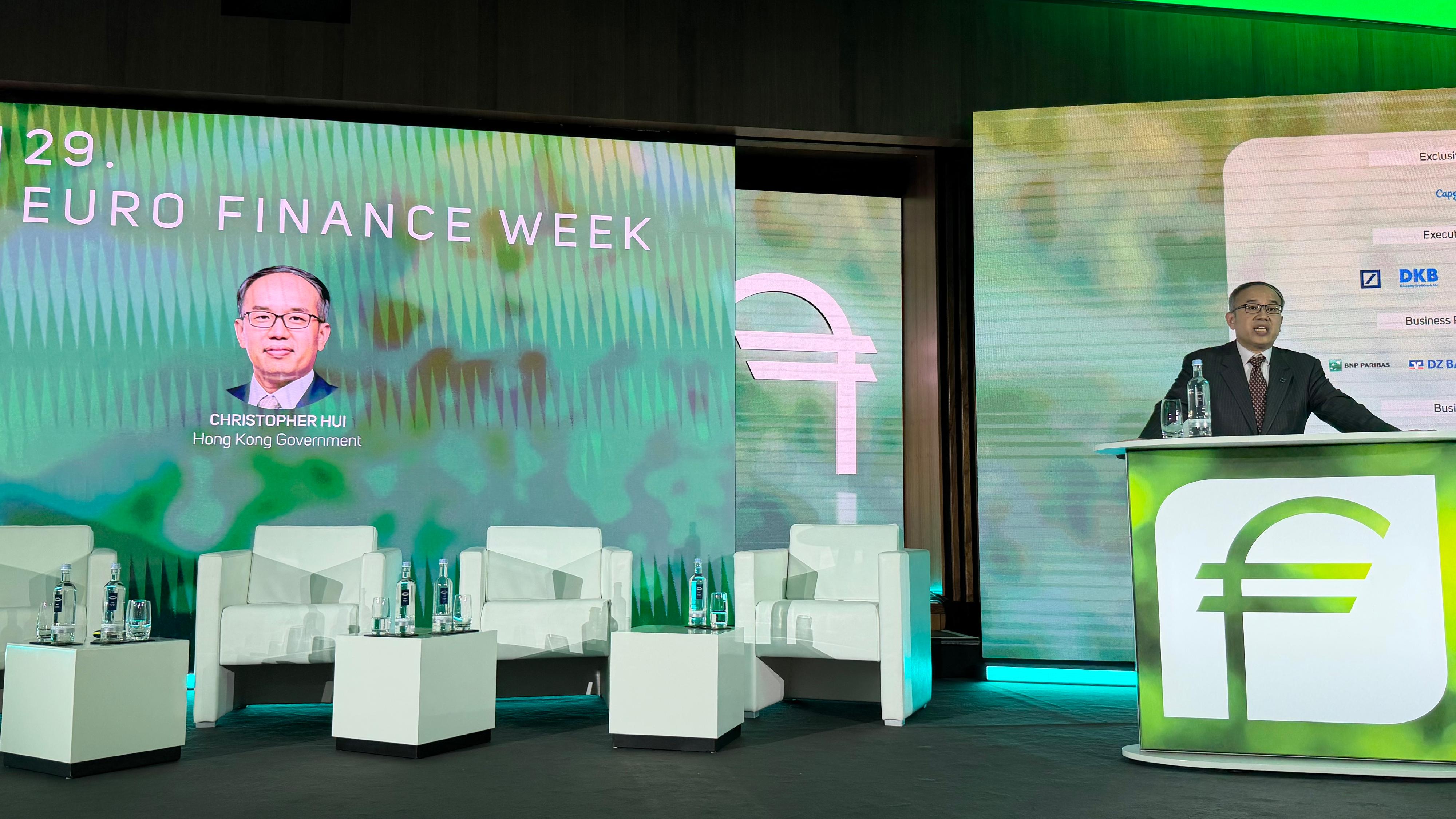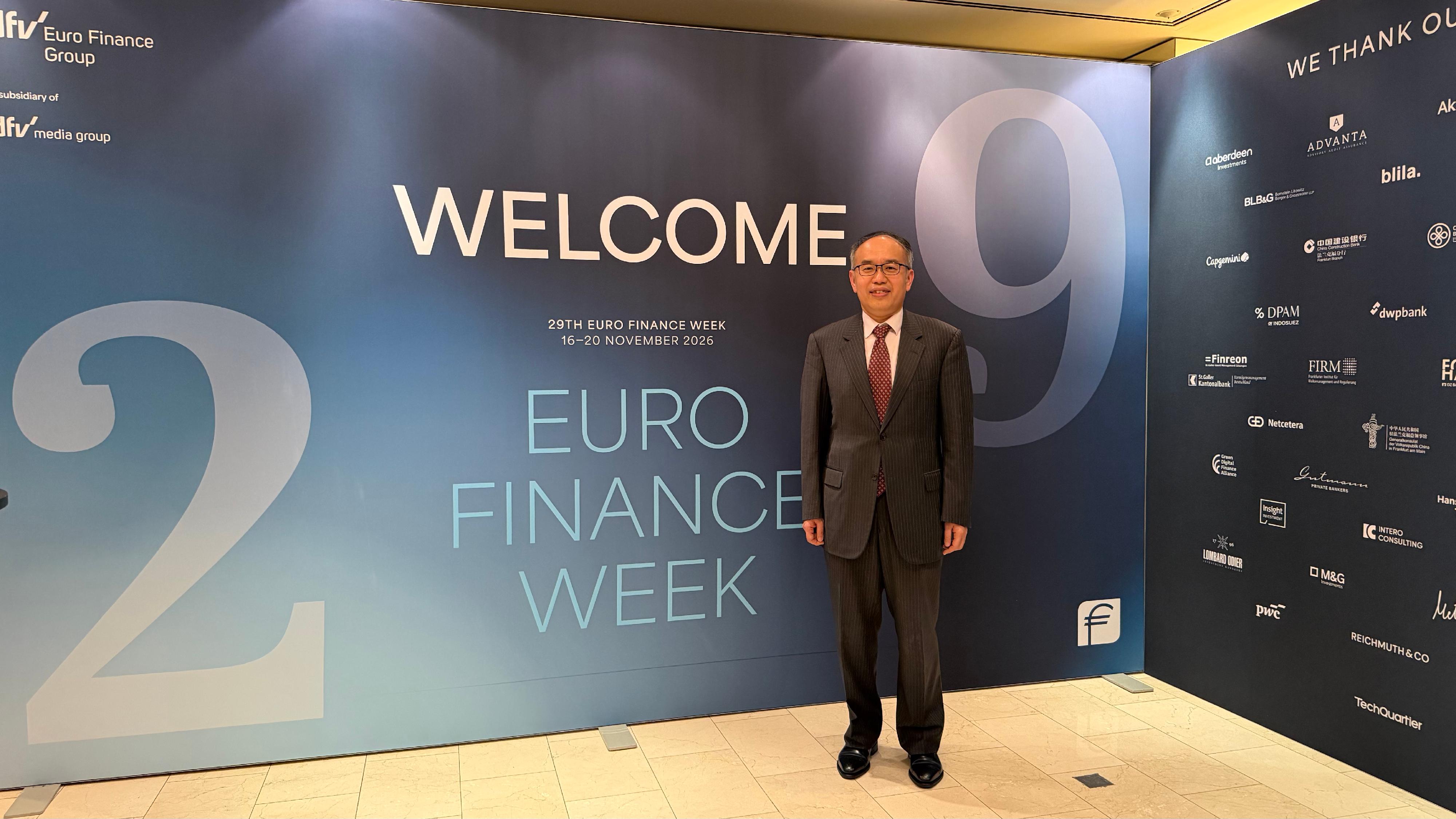

Closing remarks by SFST at 12th Green Finance Forum in Frankfurt, Germany (English only) (with photos)
******************************************************************************************
Distinguished guests, ladies and gentlemen,
Good afternoon. It is a great pleasure of mine to be here in Frankfurt. In fact, I am only here for less than 12 hours and I am leaving for Luxembourg after this. It is also an honour to deliver the closing remarks of the 12th Green Finance Forum. I thank the dfv Euro Finance Group for inviting me, and for convening such an inspiring day. Today's theme, "Changing perspectives: From Green to Blue Finance", reminds us all that the climate challenge is also a water challenge, and that finance has a decisive role in meeting both. This afternoon, I would like to share how Hong Kong, as Asia's green finance hub, is connecting capital, standards and regions to support that shared mission.
Let me start with the bigger picture. Global climate finance flows reached an all-time high of around US$1.9 trillion in 2023, more than doubling in three years. If this pace continues, annual climate investments could reach at least US$6 trillion by 2028. Much of this demand will come from Asia, home to fast-growing economies, major manufacturing bases and many of the cities and coastlines most exposed to rising seas, floods and extreme heat. Meeting Asia's needs is therefore central to meeting the world's climate goals.
China is firmly committed to this transition. Its 15th Five-Year Plan, our country's national development blueprint for 2026 to 2030, sets the goal of a comprehensive green transformation of the economy and society. China aims to peak its carbon dioxide emissions before 2030 and achieve carbon neutrality before 2060. Hong Kong, being a part of our own country, aims to achieve carbon neutrality slightly earlier, before 2050, and to cut carbon emissions by half before 2035.
As one of the world's leading international financial centres, Hong Kong is also rising as an international green finance centre. Last year, green and sustainable debt issued in Hong Kong, including bonds and loans, exceeded US$76 billion. Green and sustainable bonds arranged in Hong Kong amounted to around US$38 billion, making Hong Kong the largest market in Asia for these bonds for eight consecutive years.
What, then, does Hong Kong bring to the table? Here I would highlight three roles.
First, we are a connector of capital. Hong Kong is part of China, but under the "one country, two systems" principle, we keep our own legal, financial and monetary systems. This means we combine the free flow of capital, a common law system, a freely convertible currency and deep international markets with unique access to the Chinese Mainland. We bring issuers, projects and green technologies from the Chinese Mainland and the wider Asia together with global investors, including many of you here in Europe.
Second, we are a builder of standards. Capital flows most freely where definitions are clear and information is trusted. Hong Kong is aligning our frameworks with international standards, while serving as a bridge between the Chinese Mainland, Asia and the rest of the world.
Third, we are a regional platform. Hong Kong is part of the Greater Bay Area, one of China's most dynamic economic regions, comprising Hong Kong, Macao and nine cities in neighbouring Guangdong Province, including Shenzhen which is now the centre of focus with the APEC (Asia-Pacific Economic Cooperation) Economic Leaders' Meeting taking place. We also work closely with economies participating in the Belt and Road Initiative across Asia, the Middle East, Africa and beyond. Across these regions, we help partners access financing, expertise and markets, turning ambition into investable projects.
Let me now turn to how we are delivering on these roles, starting with the bond market.
The Hong Kong Government has led by example. Since 2019, we have issued government green bonds totalling about US$35.6 billion. These include green bonds for institutional investors denominated in Renminbi (RMB), US dollars and Euro, retail green bonds for local citizens, and tokenised green bonds issued on blockchain-based platforms. Our first tokenised green bond in 2023 was the first of its kind issued by any government in the world. In September this year, our latest digital bond offering of around US$2.6 billion became the largest digital bond issuance in the world. We have a lot of interest from European investors, and some of them I have met today.
Hong Kong has also become a preferred venue for public-sector issuers from the Chinese Mainland. In May this year, China's Ministry of Finance issued RMB green sovereign bonds in Hong Kong for the first time, totalling RMB6 billion. Provincial and city governments in the Chinese Mainland, including Shenzhen, Hainan and Guangdong, regularly issue green, sustainability and social bonds in Hong Kong.
And speaking of today's theme, blue finance is already part of this story. Since 2022, these local governments have issued a series of blue bonds in Hong Kong, financing marine and water-related projects. Guangdong Province, for example, issued a green and blue sustainability bond in Hong Kong in September this year, alongside a bond for a major water infrastructure project. These issuances show how Hong Kong's market can channel capital into ocean conservation, water security and resilient infrastructure.
Water connects not only our ecosystems, but also our economies. Stronger maritime connections and resilient supply chains help businesses reach global markets and sustain trade in an uncertain international environment. In the realm of maritime decarbonisation, Hong Kong in particular has a unique role to play: our proximity to the Chinese Mainland, which is home to the world's largest manufacturing bases for green maritime fuel, means that we have reliable supply that makes us prime for developing green fuel trade. To this end, we are now working closely with industry partners to develop such a trading platform, tapping into the immense potential of this emerging sector as the maritime world steers irreversibly towards a green future and global green fuel bunkering breaks successive records. At the same time, we are determined to build Hong Kong into a green port, and we are working with port operators on formulating a roadmap for the green transformation of our container terminals. All these initiatives create opportunities to connect international capital with cleaner infrastructure and technology, supporting more sustainable and resilient trade between Asia, Europe and beyond. On this front, I invite any of you interested to come to us and to see how Europe can be part of these opportunities.
To attract more issuers to the market, the Hong Kong Government offers a grant scheme that subsidises bond issuance and external review costs for green and sustainable debt. The scheme has been extended to 2027 and now covers transition bonds and loans. As of early October, it has supported close to 720 debt instruments, with total underlying issuance of over US$200 billion. Since April this year, a higher subsidy rate has applied to instruments aligned with Hong Kong's green classification system, encouraging the market to adopt credible standards.
Beyond debt, Hong Kong Exchanges and Clearing (Hong Kong Exchanges and Clearing Limited), or HKEX, the operator of our stock exchange, launched HKEX Green Equity last month. This voluntary designation helps investors identify listed companies with significant green business activities.
This brings me to standards, the second pillar of connectivity.
On disclosure, Hong Kong published its own sustainability disclosure standards in December 2024. They are fully aligned with the global baseline standards issued by the International Sustainability Standards Board, or ISSB, and have been effective since August 2025. Our roadmap provides a clear pathway for large publicly accountable entities to fully adopt the ISSB Standards no later than 2028. The IFRS Foundation (International Financial Reporting Standards Foundation), the ISSB's parent body, has confirmed Hong Kong as among the first set of jurisdictions with a target of full adoption. In June this year, our accounting profession's standard-setting body, the Hong Kong Institute of Certified Public Accountants, was appointed by the IFRS Foundation as an official ISSB Training Partner.
For the audience in Europe, I would stress one point: global baseline standards make capital truly mobile. When a European investor reads the sustainability report of a Hong Kong-listed company, it should be comparable, decision-useful and trusted.
On taxonomy, our central bank, the Hong Kong Monetary Authority (HKMA), published the Hong Kong Taxonomy for Sustainable Finance in 2024. It is aligned with the taxonomies of both the Chinese Mainland and the EU (European Union), helping investors across markets speak a common language. An expanded phase, published this January, increased coverage to 25 economic activities, introduced transition elements, and added climate change adaptation as a new environmental objective.
A further expansion, which we have consulted the public earlier on this year, would increase coverage of our taxonomy to 39 activities. It adds key enabling technologies such as battery manufacturing and recycling, and practical transition pathways for hard-to-abate sectors like air transport, and iron and steel. Importantly for today's discussion, it introduces a process-based approach to adaptation, with 24 adaptation measures focusing initially on shoreline protection and flood management. As a coastal city, in Hong Kong, we know resilience against water-related risks is not optional. Making adaptation investable is a key step in mobilising private capital for it.
Ladies and gentlemen, the third pillar is connecting regions, and the carbon market is a good example.
The HKEX's international carbon marketplace, Core Climate, offers trading of voluntary carbon credits, settled in Hong Kong dollars and RMB. It now has over 140 registered participants, offering credits from over 60 projects certified under leading international standards such as Verra and Gold Standard. Last month, Core Climate completed two cross-boundary pilots with partners in the Greater Bay Area. The first enabled Hong Kong companies to purchase around 100 000 green electricity certificates from the neighbouring Mainland Chinese power market. The second tested settlement arrangements for carbon emission allowances traded in the city of Shenzhen which is our neighbour. Core Climate is also expanding co-operation with Brazil, Malaysia and Kazakhstan, and exploring new environmental products such as Sustainable Aviation Fuel certificates and green hydrogen certificates.
Technology amplifies these efforts. Under a tokenisation initiative led by the HKMA, a tokenised carbon credit transaction was tested last year to improve transparency and traceability. Building on this, the HKEX is exploring the establishment of a blockchain-backed, multi-asset tokenisation platform, and plans to conduct a tokenised carbon credit pilot by the end of this year. The pilot will translate the concept of tokenised carbon markets into real-world transactions and practical application.
We are also developing Hong Kong into a green fintech hub. In September, a green technology accelerator was launched in Hong Kong to help green technology projects in Belt and Road regions become investment-ready, and to connect them with investors and capital.
None of this is possible without people. Our green finance talent subsidy scheme, extended to 2028, has supported over 11 000 applications for training, covering nearly 130 eligible programmes and qualifications. We are building a talent pool equipped for green transition and, increasingly, blue finance.
Let me now look ahead.
First, we will deepen our markets. We will continue our government sustainable bond issuance, explore innovative and digital formats, and welcome more issuers from our motherland, Asia and beyond, including in blue and adaptation finance.
Second, we will strengthen standards. We will support the practical implementation of ISSB-aligned standards, finalise the latest expansion of our taxonomy, and keep both aligned with international frameworks to support cross-border capital flows.
Third, we will build a stronger international carbon market. Working with the relevant authorities in the Chinese Mainland, we will study our country's participation in international carbon markets, including standards, registration, trading and settlement, and develop practical cross-border trading cases.
Fourth, and fundamentally, we will deepen partnerships. Europe has been a pioneer in sustainable finance, from taxonomy to disclosure and many others. Frankfurt is a natural partner. Hong Kong's taxonomy is aligned with that of the EU, and our Government has issued green bonds in Euro. I see ample room for collaboration, from bringing Asian green and blue projects to European investors, to sharing experience on standards, technology and talent.
Ladies and gentlemen, water connects us all. Rivers cross borders, oceans link continents, and ports, like Hong Kong's, have long connected Asia and Europe through trade. Finance should flow the same way, across markets, standards and regions towards a greener and bluer future. In particular, in the Chinese language, water means wealth. So on that front, we hope and we will make sure that water will push for progress not just financially but also socially. Hong Kong as always stands ready to be your gateway to Asia, and Asia's gateway to the world.
Thank you, and I wish you all a pleasant evening at the reception.
Ends/Wednesday, November 18, 2026
Issued at HKT 12:00
Issued at HKT 12:00
NNNN