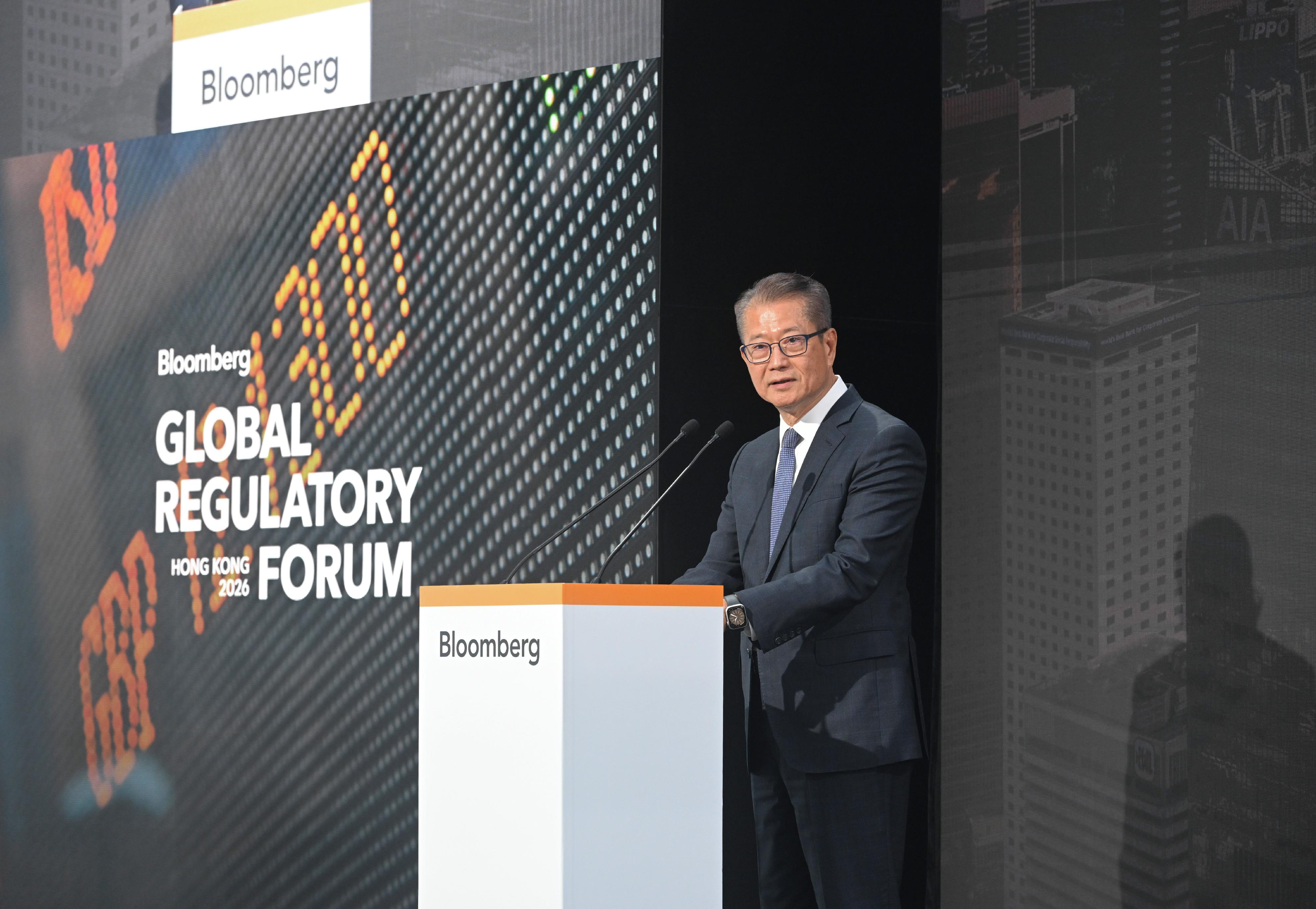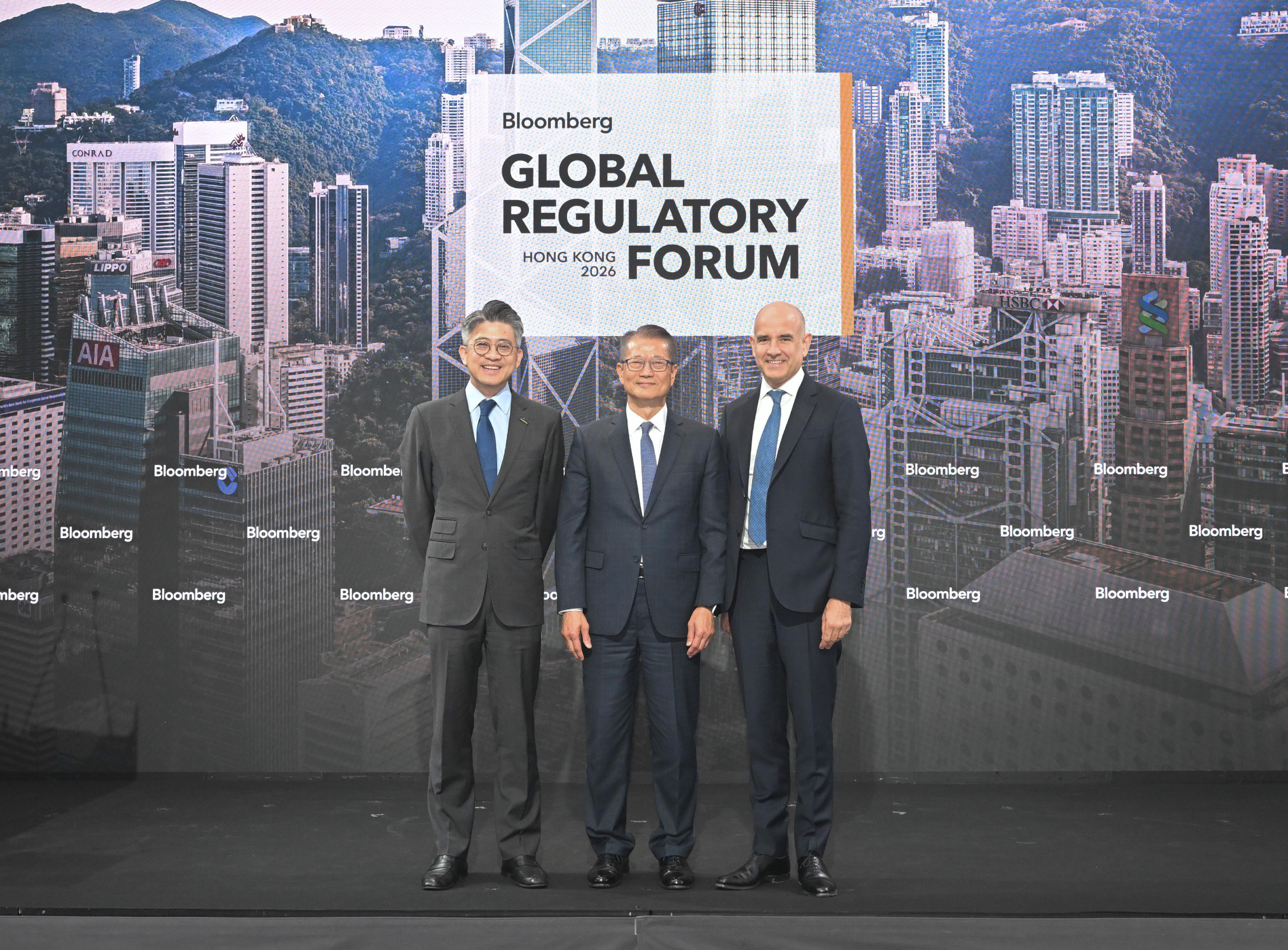

Keynote speech by FS at Bloomberg Global Regulatory Forum 2026 (English only) (with photos/video)
******************************************************************************************
Constantin (European Director and Global Head of International External Relations of Bloomberg, Mr Constantin Cotzias), Bing (Asia Pacific Chairman at Bloomberg, Mr Bing Li), distinguished guests, ladies and gentlemen,
Good afternoon. It is a pleasure to see the Bloomberg Global Regulatory Forum back in Hong Kong after two editions in New York. To our friends who have travelled from afar, a very warm welcome.
A changing landscape
We meet at a time when the global financial landscape is fast changing and becoming increasingly complex. Interest rates in major economies have turned higher again, and geopolitics continues to reshape trade, supply chains and investment. When money is no longer cheap and the map is no longer simple, investors ask two questions of every market. Is my capital safe here? And where is the growth potential?
At recent international meetings, from the IMF/World Bank Annual Meetings in Bangkok to the Global Financial Leaders' Investment Summit here in Hong Kong, one message came through again and again: diversification across markets, currencies and asset classes, and in particular rebalancing towards Asia.
In Hong Kong, we see this happening.
Our total bank deposits grew by 7.7 per cent in the first nine months of this year, to nearly $21 trillion. In the first 10 months, more than 120 new listings raised over $400 billion, some 40 per cent more than the whole of last year. And international cornerstone investors have taken part in more than 80 per cent of our IPOs this year. Together, these figures reflect a considered choice: Hong Kong.
Two reasons
Why Hong Kong? There are at least two reasons. First, Hong Kong is a safe harbour, built on openness and consistency: the common law, the free flow of capital and information, a stable currency and regulation aligned with international standards. None of this is new, but that is precisely what investors value.
Second, growth. Chinese Mainland enterprises are making breakthroughs in artificial intelligence and robotics, biotechnology, new energy and advanced manufacturing. Many are now global leaders in their respective fields. I have met the founders of some of these firms, and I was impressed by their creativity, innovation and ambition. Hong Kong is the gateway through which global investors can access these opportunities. In the first three quarters of this year, technology enterprises together accounted for more than half of IPO funds raised in Hong Kong.
The principle to uphold
Indeed, all these are underpinned by the dual mandate of Hong Kong's approach to financial regulation: prudent regulation and market development facilitation. I said so at this Forum three years ago, and it remains our guiding principle.
On regulation, take our stock market for example. More than 500 listing applications are in the pipeline. We welcome them, and will continue to uphold the quality of our listings. Applicants come not only from the Chinese Mainland, but also from Southeast Asia and, increasingly, the Middle East and Central Asia. That is why our regulators work closely with their counterparts on the Chinese Mainland and overseas, stepping up cross-boundary co-operation in information exchange, supervision and enforcement. Investors come here because they trust what is listed here. That reputation, built over many years, is our most valuable asset.
The Five-Year Plan and Finance+
That is the regulatory side of our mandate. The other side is development, and it is continuous development that drives us forward. This thinking runs through Hong Kong's first Five-Year Plan, published in September. Finance is a key pillar of our "Four Centres, One Hub" development strategy, and our vision for it is "Finance+": leveraging finance to empower other sectors of the economy, from innovation and technology to trade, shipping and green development.
Consider innovation, which needs capital. Our task is to offer a complete fund-raising chain, so that a technology company can raise capital here at every stage of its growth. Beyond private equity, venture capital and public markets, an important link is patient capital. Through the Hong Kong Investment Corporation, we are building an ecosystem to support emerging and future industries.
Deeper markets
As an international financial centre that serves the real economy, we must also offer a broader range of services. That is why we are developing our fixed income, currency, gold and commodities markets, where we see considerable potential to grow.
Offshore RMB business is our unique competitive advantage. The RMB is being used more widely around the world, and our country has set a clear objective of advancing its internationalisation. At the same time, international investors are increasingly interested in holding RMB-denominated assets with better liquidity. In response, we are broadening the product offerings, strengthening the related infrastructure and deepening market liquidity. The latest addition came this morning, with the launch of the Offshore RMB Bond Index, which will pave the way for new RMB index-tracking products and ETFs (exchange-traded funds).
We are also moving forward quickly in the commodities market. In gold, we are increasing storage capacity, and a central gold clearing system connected with the Shanghai Gold Exchange has been in trial operation since July. On the trading side, the HKEX (Hong Kong Exchanges and Clearing Limited) is preparing RMB gold futures with physical delivery.
By the way, two of our recent initiatives share the same partner. HAU, the new reference price for gold in Asian trading hours, and the RMB Bond Index launched this morning were both developed with Bloomberg. Bing, Bloomberg follows the data. In gold and in RMB bonds, the data says Hong Kong. I expect it will keep saying so.
Newer ground: AI
So far, I have spoken of familiar ground. AI and digital assets are newer ones, where regulators everywhere are still working out the answers.
AI is clearly reshaping finance. In a recent survey of large financial firms by our Securities and Futures Commission, 95 per cent of respondents expect their use of AI to accelerate within a year. Three in 10 already use AI agents. In time, I expect more financial institutions to become AI-native, that is, institutions whose services and operations, even business models, are designed and built around AI.
These changes raise the question of accountability. When an AI agent acts, who answers for what it does? Our position is clear. AI agents may carry out tasks, but the responsibility remains with the institution that deploys them and the people who oversee them. An algorithm has no licence to lose and no reputation to protect. The institution has both.
The more challenging task is making that principle hold in daily operations. Banks have long been required to know their customer. They will now need to know their agent as well: who it is, what it is authorised to do, and how a person steps in when something may go wrong. This month, the Hong Kong Monetary Authority brought together experts from finance, technology and academia to work through these questions, in an initiative known as Project SAGE. And in the joint supervisory sandbox of our four financial regulators, 36 projects on AI agents have been selected for testing.
AI is also changing the threats we face. The model that helps a bank detect fraud can help a criminal find a weakness in its systems. Our regulators have therefore asked firms to review their defences, on the assumption that attacks will become faster, more frequent, more automated and launched on multiple fronts at the same time.
Digital assets
Meanwhile, digital assets raise a different question: that is, where the boundary of regulation should lie. Our principle is simple: same activity, same risks, same regulation.
On stablecoins, we have moved forward step by step. Of the 36 applicants in the first round, two received licences in April, and both have since launched Hong Kong dollar stablecoins. Our emphasis is on genuine use cases and credible business models: stablecoins should address pain points in business operations and in financial activities. Cross-border payment is a good example.
On tokenisation, the market is moving from pilots to regular use. In Hong Kong, tokenised funds offered to the public have grown about seven-fold in a year, and since last month two tokenised money market funds have traded around the clock on a licensed platform. Our approach is consistent: the same requirements as for conventional products, with additional safeguards for the new risks.
Before the end of this year, we will introduce a bill to complete the regulatory perimeter, extending licensing to those who deal in, advise on, manage and act as custodians of digital assets.
Above all, we are firm on one point: Decentralisation does not mean less accountability.
Close
Ladies and gentlemen, capital, data and code now cross borders in seconds. Rules travel more slowly, and no regulator can supervise these markets alone. Hong Kong will share what we learn, and we look forward to learning from you and working with you.
Technology will go on changing how finance works. It will not change what finance rests on, which is trust. Maintaining trust remains the work of institutions and regulators, and of the people in this room.
For our part, we will keep to the approach that has served us well: open to innovation, clear about responsibility and firm on standards.
I wish you all a rewarding Forum and, for those visiting, a most enjoyable stay in Hong Kong, Asia's world city. Thank you.
Ends/Monday, November 16, 2026
Issued at HKT 15:25
Issued at HKT 15:25
NNNN