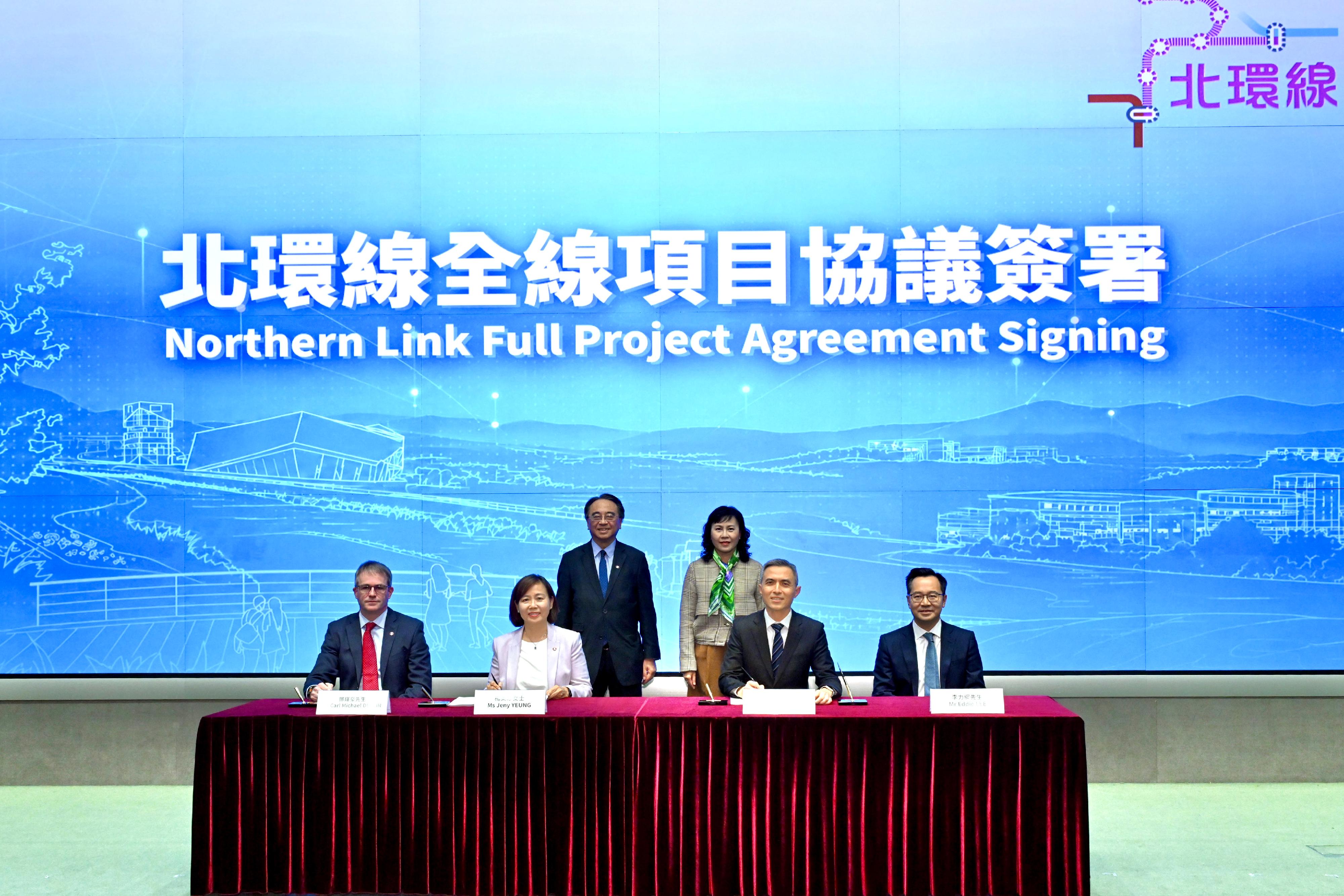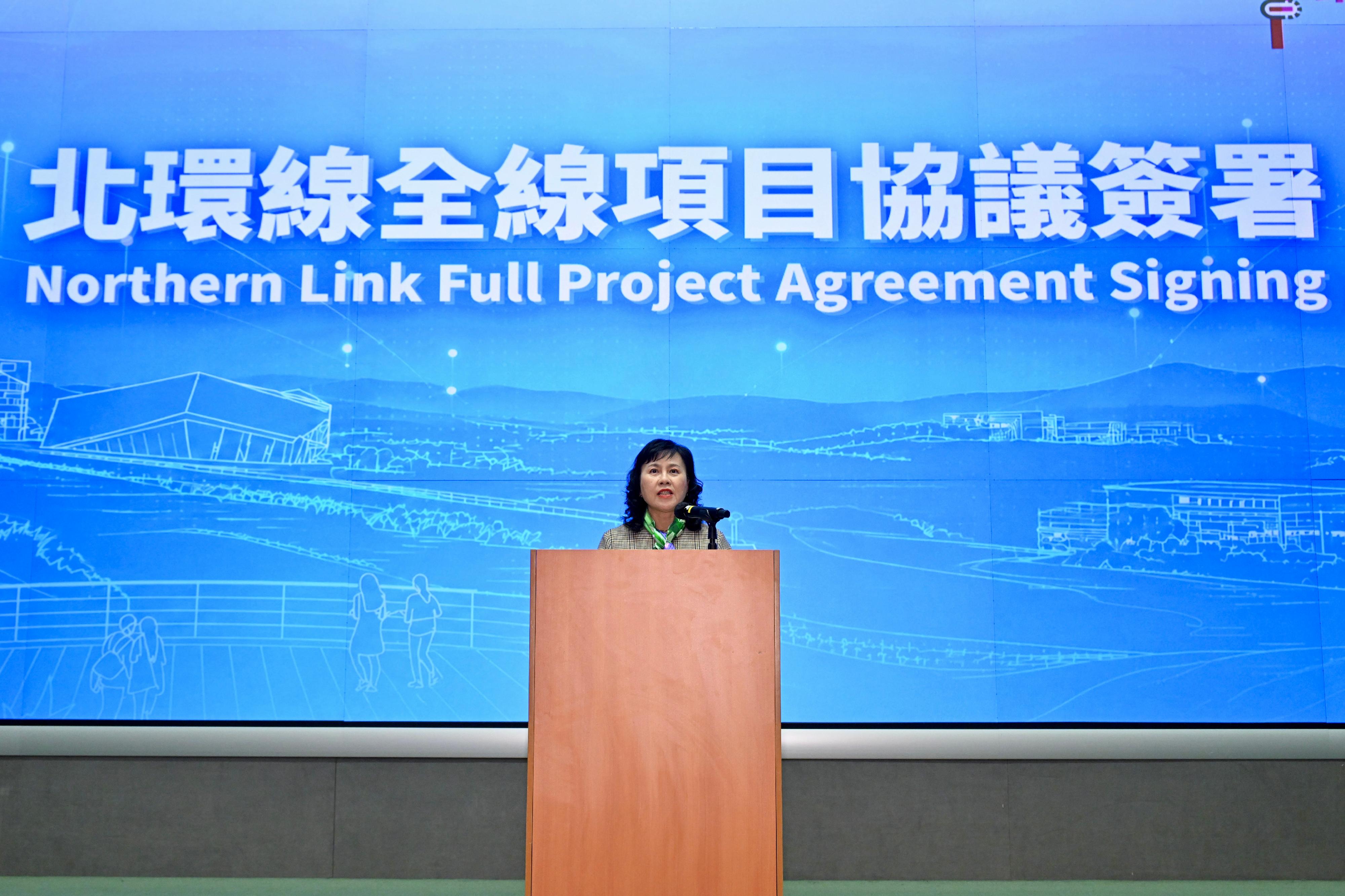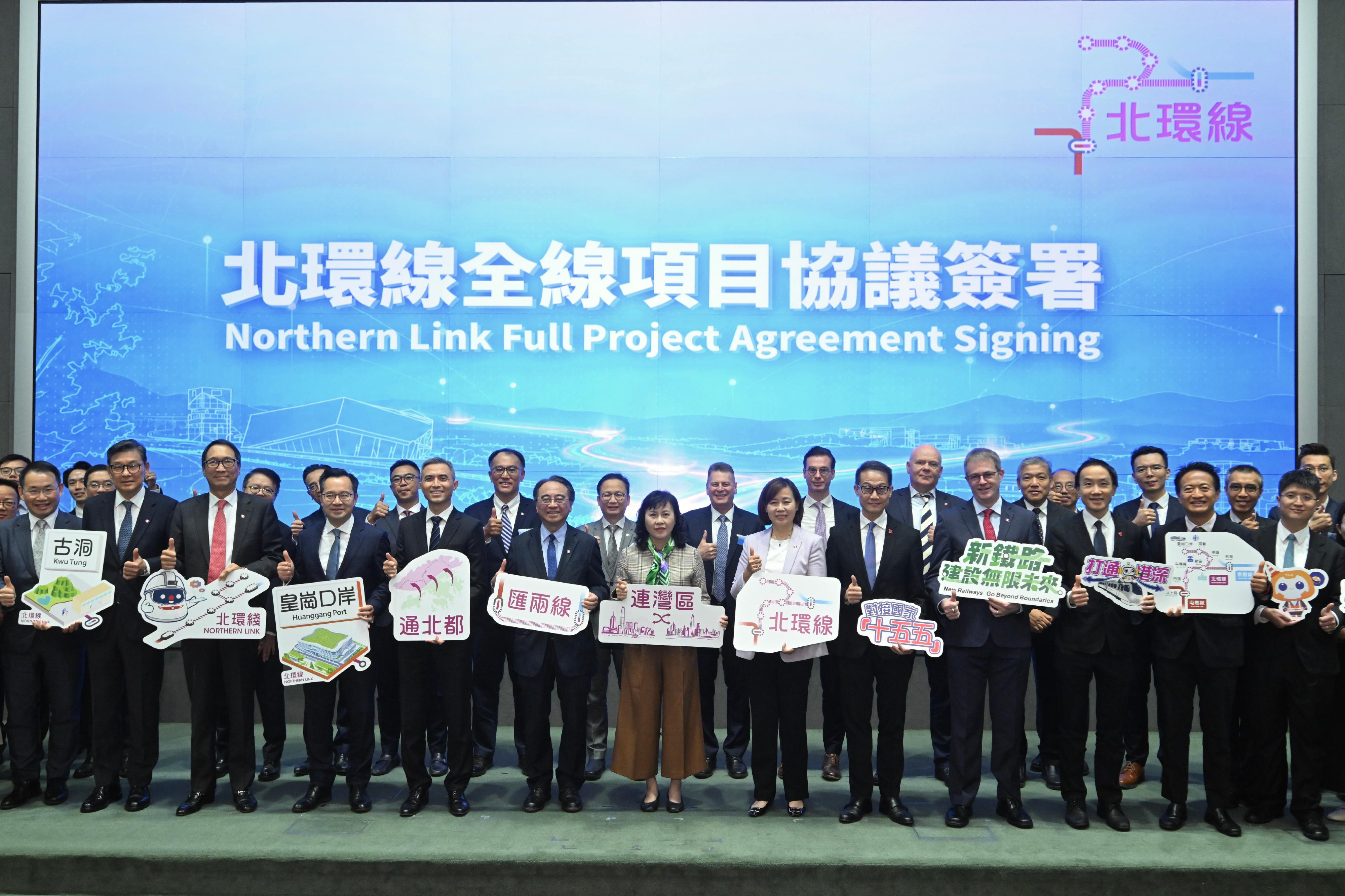



Government and MTRCL execute project agreement for full Northern Link Project (with photos)
******************************************************************************************
Ms Chan said, "The NOL Project, comprising the Main Line and the Spur Line, is a strategic railway project under Hong Kong's First Five-Year Plan and actively aligns with the strategies set out in the National 15th Five-Year Plan Outline. Offering both local commuting functions within Hong Kong and cross-boundary railway services, the project will open up new transport corridors for both local and cross-border travel upon full commissioning. The project features three highlights, namely 'Serving the Northern Metropolis, Joining Two Lines, and Linking the Greater Bay Area'. First, the project will serve as the main public transport backbone for several new development areas in the Northern Metropolis including the innovation and technology clusters in the San Tin Technopole and the Loop, driving the expedited development of the Northern Metropolis; Secondly, the project will link the Tuen Ma Line and the East Rail Line to form a railway loop, significantly enhancing the coverage and resilience of the railway network; Thirdly, the project will connect to the Huanggang Port, which adopts the innovative clearance mode of 'collaborative inspection and joint clearance', thereby integrating the metro networks of Hong Kong and Shenzhen and strengthening infrastructure interconnectivity in the Guangdong-Hong Kong-Macao Greater Bay Area.
"To enhance the speed and efficiency of railway development, over the past year the Government and the MTRCL teams have taken forward a series of key initiatives to reduce cost and expedite construction, with three major decisive breakthroughs in particular: First, in February this year, the Highways Department promulgated the Hong Kong Railway Standards, introducing the most suitable railway standards of the nation and various places in the world to facilitate the wider adoption of innovative technologies, materials, equipment and systems. The Railway Checking Unit has been established concurrently to handle building plan submissions for railway projects in a dedicated manner, substantially reducing the time for handling building plans by 30 to 50 percent; Secondly, various streamlining proposals have been incorporated in the Northern Metropolis Development Bill, such as simplifying the procedures and requirements for applications for construction noise permits, to further streamline the implementation process of the NOL Project and other transport infrastructure projects in the Northern Metropolis; Thirdly, implementing the NOL Main Line in combination with the Spur Line as one project to achieve synergies not only reduces cost but also advances the timetable of the Spur Line by two years to commission simultaneously with the Main Line by 2034 or earlier," Ms Chan added.
Through the above breakthroughs, coupled with the cost-saving benefits brought about by the shortened construction period, the overall construction cost of the whole NOL Project has been reduced by 28 per cent as compared with the original estimate. During the construction stage, the Government will continue to work closely with the MTRCL to explore the wider application of innovative technologies to expedite delivery and enhance efficiency, with a view to commissioning as early as practicable.
The Government, supported by an independent checking consultant, has critically examined the financial estimates provided by the MTRCL in relation to Part 2 of the NOL Project. The estimated capital cost (covering railway tunnel, stations, depot as well as electrical and mechanical systems and installations of the entire line) is verified to be about $54.8 billion (in July 2025 prices). Together with the estimated capital cost for Part 1, the estimated capital cost of the entire NOL Project is about $86.2 billion (in July 2025 prices), which is lower than the original estimate by 28 per cent.
The Chief Executive in Council approved the grant of sites at Ngau Tam Mei Area 3A, 3D and 4A; San Tin Area 2A and 2G; Kwu Tung North Area 23 and 26 (East); as well as part of the site for residential use in the proposed Au Tau New Development Area, to the MTRCL for residential and commercial development under the "Rail-plus-Property" model. A fixed lump sum would be deducted from the full market-value land premium of the sites assessed on a "with-railway" basis in the future as funding support to the MTRCL in implementing Part 2 of the NOL Project.
The NOL Main Line involves the construction of a 10.7-kilometre-long underground railway and five stations. There will be two interchange stations at Kam Sheung Road Station and Kwu Tung Station connecting with the Tuen Ma Line and the East Rail Line respectively, as well as three intermediate stations at San Tin, Ngau Tam Mei and Au Tau. Upon commissioning, the travelling time between Kam Sheung Road and Kwu Tung during peak hours will be significantly reduced from the current 60 minutes to 12 minutes. The Spur Line involves the construction of an underground railway of about 6 kilometres in length branching off from San Tin Station on the NOL Main Line, of which the Shenzhen section is approximately 1.1 kilometres long. There will be three new stations, including intermediate stations at Chau Tau and the Loop, as well as the terminal at the Huanggang Port in Shenzhen. The travelling time between San Tin and the Huanggang Port is expected to be only about 11 minutes upon commissioning.
Ends/Tuesday, November 10, 2026
Issued at HKT 17:38
Issued at HKT 17:38
NNNN