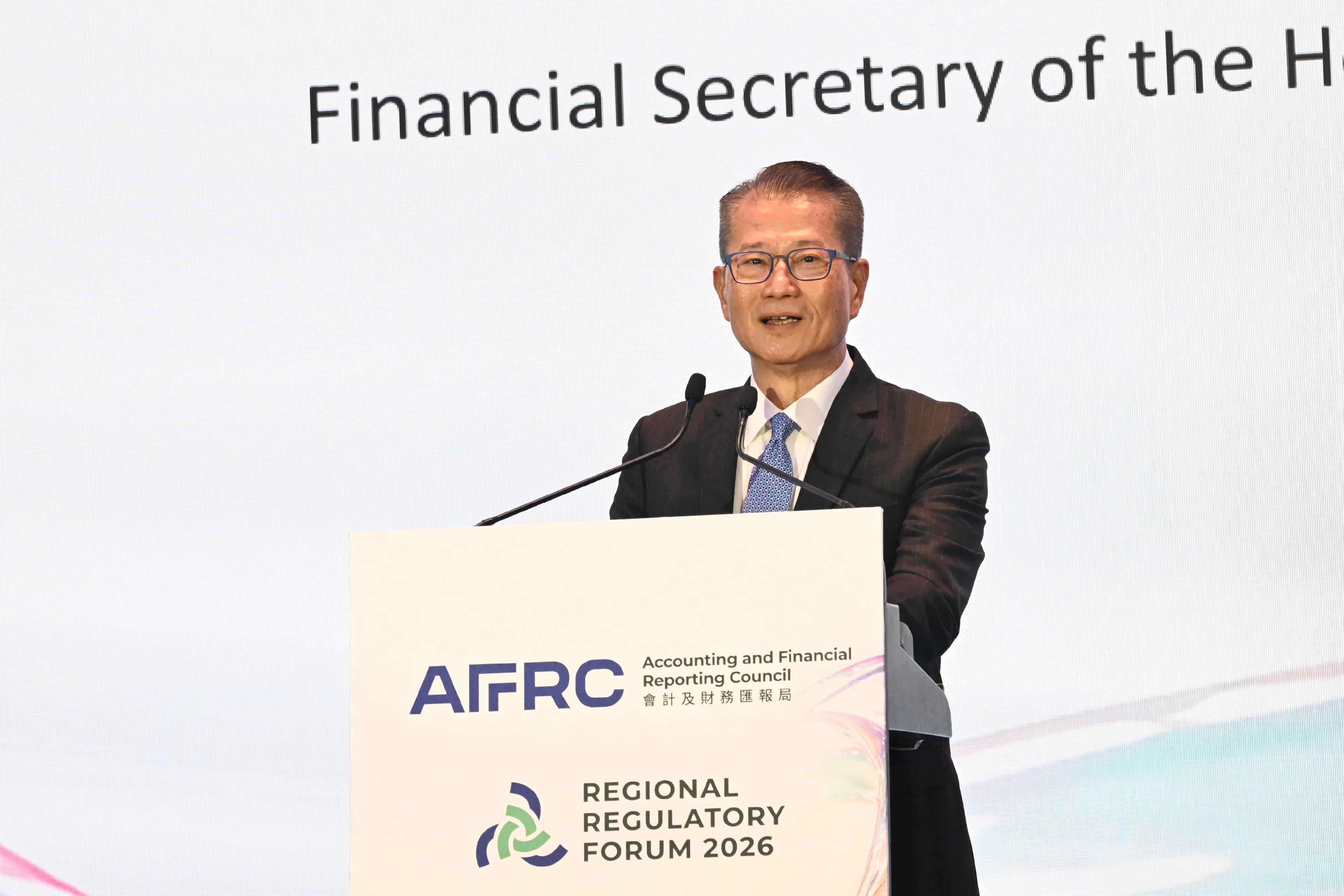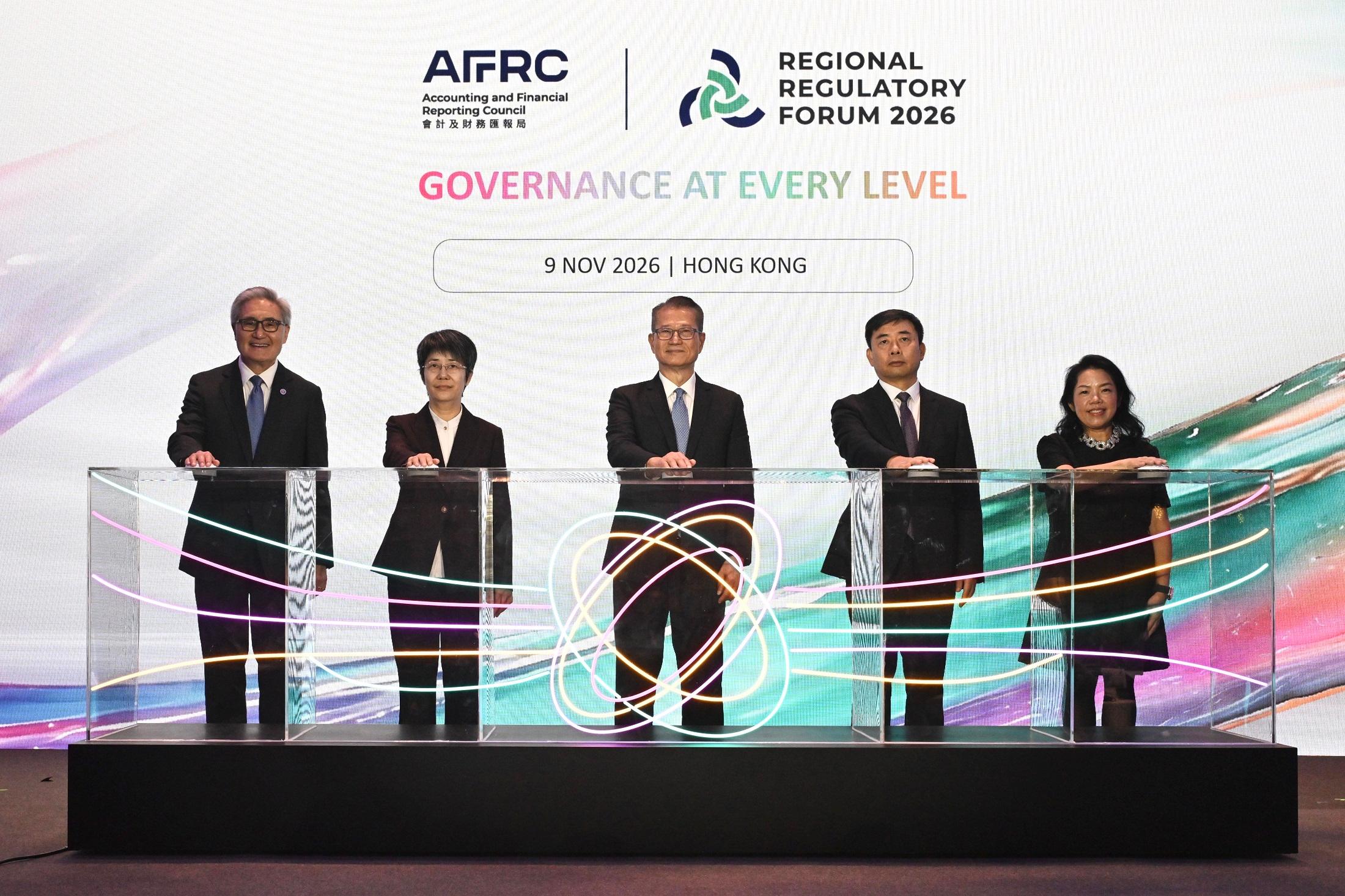

Speech by FS at Accounting and Financial Reporting Council Regional Regulatory Forum 2026 (English only) (with photos)
******************************************************************************************
尊敬的郭婷婷副部長 (Vice Minister of the Ministry of Finance Ms Guo Tingting), 朱文部長 (Director-General of the Coordination Department of the Liaison Office of the Central People's Government in the Hong Kong Special Administrative Region, Mr Zhu Wen), David (Chairman of the Accounting and Financial Reporting Council (AFRC), Dr David Sun), Janey (Chief Executive Officer of the AFRC, Ms Janey Lai), Kelvin (Chairman of the Securities and Futures Commission, Dr Kelvin Wong), distinguished guests, ladies and gentlemen,
Good morning. It is a pleasure to join you at the third Regional Regulatory Forum. I thank David, Janey and the AFRC team for bringing us together, and I warmly welcome our friends from the Mainland and from overseas.
David has spoken about the five Cs and the theme of this Forum, governance at every level. Let me take a step back and look at the trends shaping business across our region, and what they mean for Hong Kong, for the accounting profession and for regulators.
A changing business landscape
The most visible trend is diversification amid geopolitical uncertainty. Businesses are building supply chains across several countries, and investors are spreading their holdings across more markets and currencies. At the same time, regional ties are deepening. More than half of the trade in Asia now takes place within the region. ASEAN (Association of Southeast Asian Nations)’s role as a trading entity is also expanding, with its total merchandise trade growing by 14 per cent last year to US$4.4 trillion.
Our country is an important player in this process. High-level opening up is a central theme of the National 15th Five-Year Plan, and that continued opening up runs in both directions. More Mainland companies are going global. Last year, Chinese outbound direct investment rose by 11 per cent to US$214 billion, strengthening supply-chain links and industrial development co-operation with the Global South.
At the same time, our country continues to welcome international businesses, products and services. All foreign investment access restrictions in manufacturing have been removed, while service sectors such as telecommunications and healthcare are opening up further through pilot schemes.
What can we expect from all this? More investment, more partnerships, and more companies concurrently operating in several markets. With that comes a growing demand for credible financial information that can be trusted across borders.
Technology is changing business just as profoundly, with AI and digitalisation leading the way. Worldwide spending on AI is projected to approach US$2.7 trillion this year. For many businesses, AI has become a major investment priority, changing how they operate and their business model, as well as how investors assess their value. For accountants, AI is both a tool and an asset: a tool that is transforming how work is done, and a fast moving asset that must be measured, valued and reported upon like any other major investment.
Then there is green transition. Climate policy priorities may shift, but the need to finance the transition remains. In an assessment in 2024, the IMF (International Monetary Fund) estimated that emerging and developing Asia needed at least US$1.1 trillion a year for climate mitigation and adaptation, while the actual investment was only around 30 per cent. Mobilising more private capital for the transition is absolutely essential, and investors need reliable information on both the financial performance and environmental impact of such projects.
Opportunities and challenges
These developments in trade, technology and green transition are creating new opportunities as well as new demands for trust and accountability. And Hong Kong is experiencing them first-hand.
For example, diversification and opening up mean more fund-raising and cross-border investment flows. In the first 10 months of this year, there were 121 new listings in Hong Kong, and they raised more than HK$400 billion, 40 per cent more than in the whole of last year. Companies across the AI value chain are adding new depth to our market. Meanwhile, around 60 per cent of the new issuers in Hong Kong had international business operations, and some in their prospectus have earmarked proceeds for overseas expansion. More international companies from Southeast Asia, the Middle East and Central Asia are also choosing Hong Kong to list equities or to issue bonds.
The challenge follows. The work of accountants straddles jurisdictions and regulatory systems. Financial information of a company prepared in one jurisdiction may be audited in another and relied upon by investors in many others. Every link in that chain has to hold.
AI tells a similarly challenging story.
For the profession, AI is already making its mark. An AFRC study published last month found that four of the five large audit firms surveyed had begun implementing AI capabilities, although progress in broader audit automation was uneven among small- and medium-sized firms.
AI can take on routine work super efficiently. But the limitation of their output and the validity of the assumptions need to be carefully scrutinised with professional judgement. The risk of AI-fabricated documents makes it all the more important to challenge the reliability of evidence. Therefore the profession must find new ways to discharge its duty and to train and upskill its management and staff.
Three thoughts for the profession
All these point to three priorities.
First, uphold integrity at the heart of your work. Technical expertise matters, but so does the integrity behind your signature. Never compromise quality and integrity. This goes without saying for auditors. But I would like to remind accountants in business that this is your primary responsibility, because it is the output of your work that forms the very basis of your financial statements. Besides, the Board relies on your information and your advice, all the way from establishing internal control and internal audit to external financial reporting.
Second, not just build AI skills, but become AI native. Every firm, whatever its size, needs people who can apply these tools and recognise their limitations. Firms will value even more those who can use AI to help transform their business or reinvent their business model.
Third, keep investing in people. We need professionals who understand both technology and business, exercise sound judgement, uphold integrity and work effectively across markets and cultures. AI may reduce some routine work, but firms must still give young professionals the training, experience and exposure they need. The leaders of your firm in the 2030s may well be the trainee you hire today.
An invitation to fellow regulators
Ladies and gentlemen, these priorities are not for the profession alone. Regulators also have a role to play, too. Here in Hong Kong, I have given our financial regulators a dual mandate: prudent regulation and market development facilitation. We see these responsibilities as complementary and essential to the continued development of our financial markets.
Regulators can learn from one another. To our fellow regulators from the region, I extend an invitation. Let us compare notes on the global development and challenges of the profession, share regulatory experiences, and promote staff exchanges and secondments with one another.
This Forum provides a valuable opportunity to advance that dialogue. I thank the AFRC once again for organising this Forum and bringing all of us together. I wish you a stimulating and productive day. Thank you.
Ends/Monday, November 9, 2026
Issued at HKT 11:08
Issued at HKT 11:08
NNNN
Photo