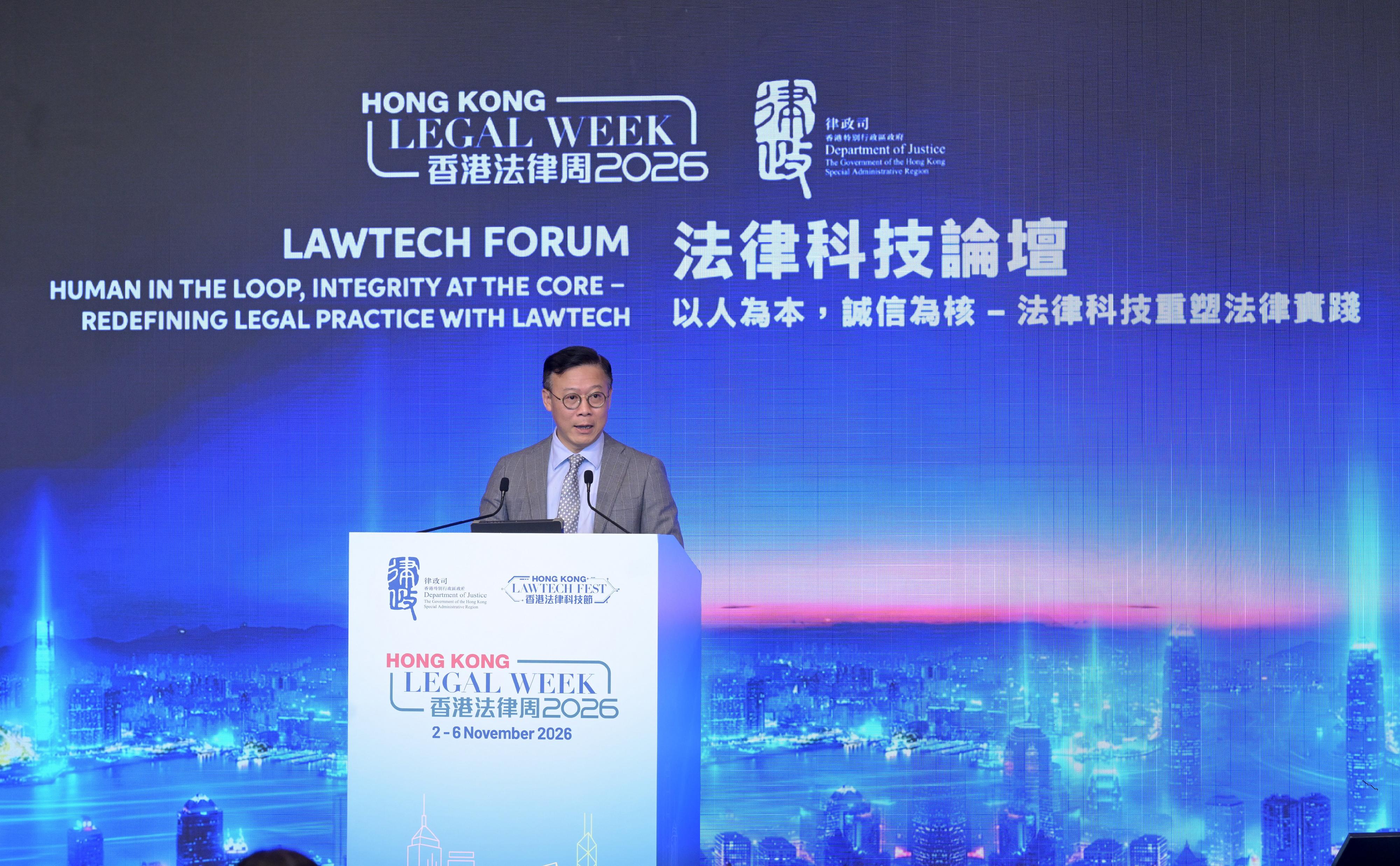

Closing remarks by DSJ at Hong Kong Legal Week 2026: LawTech Forum (English only) (with photo)
******************************************************************************************
Carmen, the Honourable Chairlady, (Chairman of the Legislative Council (LegCo) Panel on Administration of Justice and Legal Services (AJLS Panel), Ms Carmen Kan), Maggie (Member of the LegCo AJLS Panel, Ms Maggie Chan), and Dennis (Member of the LegCo AJLS Panel, Mr Dennis Leung), the Honourable Members of the LegCo AJLS Panel, ladies and gentlemen,
Good afternoon and thank you for joining us at the LawTech Forum today.
Today we have brought together an exceptional range of participants, LegCo members, AI governance experts, private practitioners, in-house counsel, barristers, arbitrators, academics, and law students, to examine one of the defining questions of our time for the legal profession - how we can embrace lawtech including AI with confidence while keeping human judgment and professional integrity at the core.
The theme of this Forum, "Human in the Loop, Integrity at the Core", says it all. Over the course of this afternoon, our discussions have shown both the scale of the opportunities before us and the clarity of the principles by which we should seize them.
Three key messages
I would summarise three key important messages. First, AI is no longer a speculative horizon. It is already embedded in our daily work. Experts in our panel session helpfully shared that how they are deploying lawtech tools for legal research, correspondence drafting, translation and document review, etc. The efficiency gains are real and widely acknowledged, routine tasks are being compressed, and time is being freed for higher-value and more human-centric work, like strategic planning and client engagement.
Second, we observe from the most constructive thematic sharing that regulatory frameworks governing AI may differ across the world, but the underlying concerns are common: confidentiality, accountability, bias and transparency, and the need for human oversight. Indeed, integrity is the fundamental common ground. AI governance with integrity means when AI moves from speaking to acting to deciding, its outputs should be verified, its reasoning and actions traced, its decisions reviewed and a named person held responsible.
This message is echoed in the insightful discussion in our panel session, which has made clear that efficiency without integrity is a false economy. Practical implementation aligns with regulatory concerns, identifying real and persistent risks on the ground: data privacy, privilege and confidentiality breaches; inaccuracies, biases, and hallucinations; insufficient governance frameworks; as well as the risk of over-reliance on automated outputs. These are genuine issues our profession is facing.
The third takeaway, for me, is the most encouraging one. Our legal profession is proactively responding to these challenges. We have heard from our esteemed panelists their active input for professional guidance, for regular best-practice reviews, for capacity building and training from classrooms in law schools to law firms and board rooms, and for a culture of critical and responsible oversight.
And that, fundamentally, is what "human in the loop" means in practice. Despites its enormous benefits, lawtech cannot displace the distinctly human qualities and attributes of empathy, judgment, and integrity lying at the heart of legal practice. Lawyers ourselves remain accountable. We are the ones who sign off. We are the ones who owe a duty to the client and to the court.
LawTech Fest
This Forum is, of course, only one element of the Hong Kong LawTech Fest, which continues alongside the Hong Kong Legal Week. I would encourage members of our profession, law students and other stakeholders to take full advantages of what else is on offer. The LawTech Exhibition is running until tomorrow. It features 15 lawtech service providers showcasing their latest solutions across legal research, automated review and data analysis, workflow management, document drafting and hearing support.
Alongside the Exhibition, the Insight Stage offers a series of interactive workshops with live demonstrations and real-time dialogue, an opportunity to see these tools in action and to further explore their capabilities and their limitations. I would encourage you to engage with the service providers, learn from them, and to challenge them with questions like in what way things could go wrong and how best to tackle the same.
The LawTech Fest is designed to help you take your next steps in adopting lawtech tools with greater confidence - whether you are from the solicitor's branch or barristers', in private practice or in-house, handling transactional work or dispute resolution.
Funding scheme
I would also take the opportunity to share the latest initiatives of the Department of Justice (DoJ). We launched a funding scheme (Funding Scheme for LawTech Solution Subscription by the Hong Kong Legal Sector) to support the legal sector in adopting lawtech this Tuesday. This is our direct response to the observations and comments we have gained from practitioners, academics and service providers during our five rounds of LexGoTech Roundtables held since the second quarter last year. The takeaway for us is clear. The cost of entry for relevant lawtech tools is a real hurdle felt most significantly by small and medium-sized law firms and junior barristers.
The funding scheme is precisely for this group of our legal profession. SME (small and medium-sized enterprise) firms account for 88 per cent of all Hong Kong law firms whilst junior barristers with seven years of call or below amounting to one-third. Our scheme will help relieve their financial burden, thereby encouraging them to adopt lawtech tools to enhance competitiveness.
With support of the two legal professional bodies as well as the DoJ's Consultation Group on LawTech Development, we have devised a list of designated lawtech service providers for the purpose of the funding scheme. These providers are featured in the LawTech Exhibition and Insight Stage I have just mentioned. This is yet another reason not to miss the exhibition and demonstrations there.
Guidance note
Our second initiative is equally exciting. I am most pleased to share that the DoJ has just issued a guidance note on the use of lawtech in legal practice. This note seeks to provide some key principles and practical guidance to assist legal professionals to harness lawtech's benefits while safeguarding against the possible risks associated with the use of lawtech and upholding their fundamental professional duties.
This is a strong echo reinforcing the very theme we have explored today. In one word, it is integrity. In two sentences, they are as follows - lawtech tools do not exonerate legal professionals as the ultimate bearers of accountability, nor their responsibility in discharging professional duties. Legal professionals always remain solely and fully responsible for all work undertaken in the course of their professional practice, irrespective of whether or not lawtech is adopted.
As we conclude this Forum, may I sincerely thank our esteemed speakers and panelists for their constructive sharing and candid suggestions, as well as all exhibitors, supporting organisations and my colleagues for their active participation and support, without which, the second Hong Kong LawTech Fest could not have been a success. Thank you.
Ends/Thursday, November 5, 2026
Issued at HKT 18:52
Issued at HKT 18:52
NNNN
Photo