

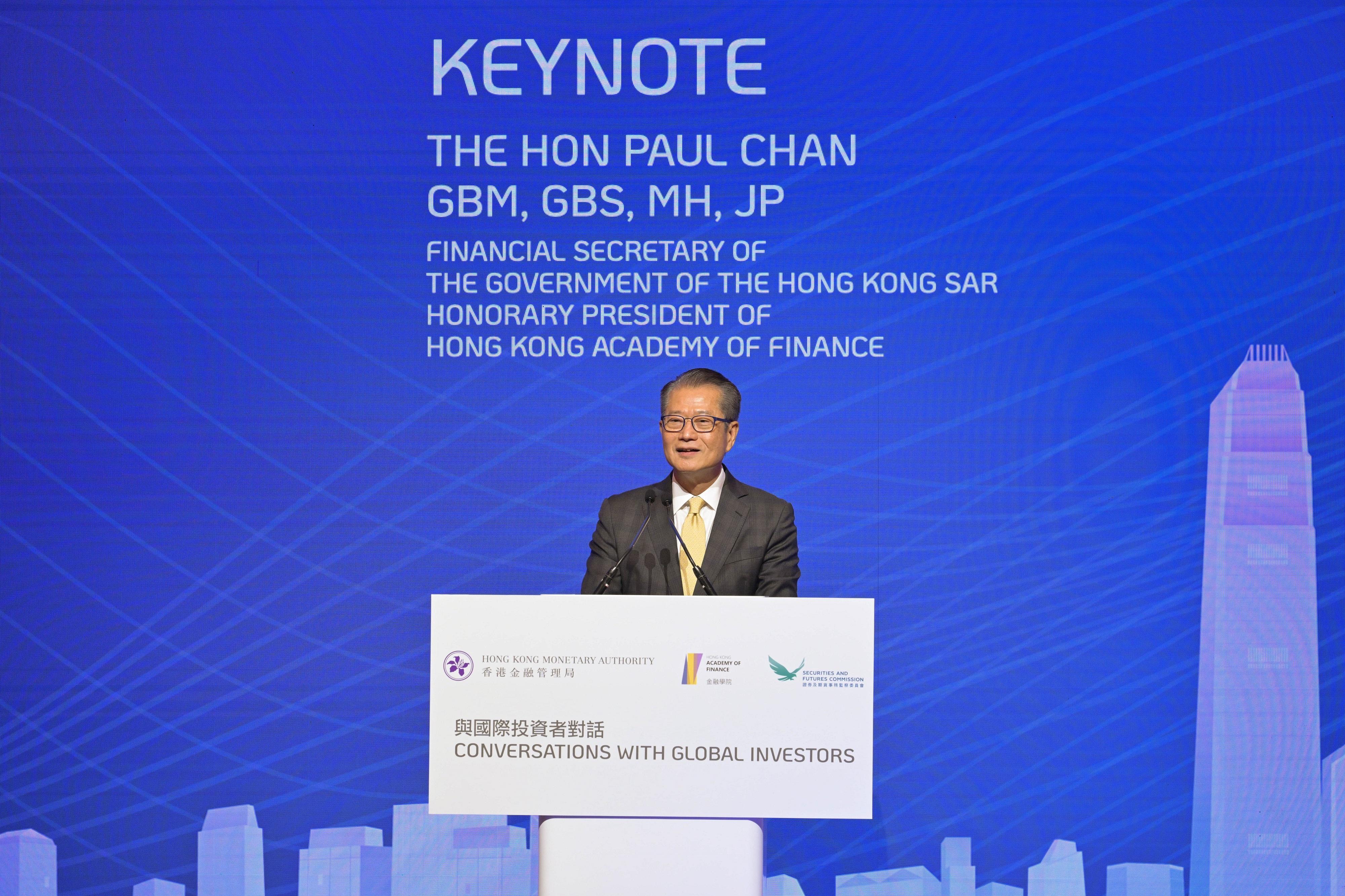
Keynote Speech by FS at Global Financial Leaders' Investment Summit - Conversations with Global Investors (English only) (with photo/video)
******************************************************************************************
Kelvin (the Chairman of the Securities and Futures Commission, Dr Kelvin Wong), Eddie (The Chief Executive of the Hong Kong Monetary Authority (HKMA), Mr Eddie Yue), distinguished guests, ladies and gentlemen,
Good morning. It is a pleasure to be with you again at the Conversations with Global Investors.
The agenda today ranges from the macro environment and asset management to private markets, artificial intelligence, Asia and wealth. The panels cover different ground, but they return to one common question. In an environment that keeps shifting, how do we identify growth opportunities, and help capital position for the long term?
To answer this, we need to look at both sides of the market: businesses and investors.
Businesses need different kinds of capital at different stages of their development. Investors, in turn, need different ways to participate in their growth, suited to their own mandates and investment horizons. The role of Hong Kong is to bring both sides together.
This morning, I would like to share our next phase of work from both perspectives, and the foundation on which both depend.
Diverse Capital for Growing Businesses
Let me begin with businesses, and how they find the right capital in Hong Kong at each stage of their development.
Take artificial intelligence as an example. A technological breakthrough does not translate automatically into commercial success. A company still has to turn technology into products, and demand into revenue, before it scales and becomes a sustainable business.
Many such companies are in China. Our country offers favourable conditions for that journey. That includes a vast domestic market, deep research capabilities, complete manufacturing and supply chain networks, and extensive testing grounds.
For a company, turning its potential into sustained growth requires capital of different forms, from one stage to the next, much like a relay.
In the early stages, a company needs equity investors who are prepared to underwrite technological and commercial risk. As it expands, it needs growth capital and industry partners. Once cash flows become more predictable, credit and bonds can play a larger part. The public markets then provide further fundraising capacity, and give early investors, including those in private markets, a channel to exit and rebalance their portfolio.
This is where Hong Kong comes into play. Under the "one country, two systems" framework, Hong Kong is closely connected to the Chinese Mainland, while our common law system, free flow of capital and international networks provide a trusted and familiar environment for global investors to take part in China's enormous growth.
Here, we already bring together venture capital, private equity, family offices and asset managers, with deep equity and bond markets. Our task is to connect them more closely across the corporate lifecycle.
At the front end of that relay, we have a vibrant venture capital and private equity ecosystem which manages around US$250 billion in assets, second in Asia only after the Chinese Mainland. But we have also come to recognise that patient capital matters more and more. Here, the Hong Kong Investment Corporation plays a catalytic role. As a government investment flagship for emerging industries, it has directed around 70 per cent of its invested capital to early and growth-stage companies. Every dollar it has invested has drawn in more than 8 dollars of long-term international capital.
From the public policy standpoint, public investment performance is measured not only by how much capital has been deployed, but by how much market participation it could mobilise. Patient capital is not judged by return expectations alone, but by the businesses that it nurtures, and the ecosystem that it builds.
As companies grow, the public markets take over. In the first nine months of this year, IPO proceeds in Hong Kong reached HK$388 billion, while follow-on fund raising reached HK$570 billion. So our market does not stop at the listing. It supports companies as they continue to develop.
Over the same period, around 60 per cent of new issuers in Hong Kong had international business operations, and some in their prospectus have earmarked proceeds for overseas expansion. This is in line with the mega trend of Chinese companies going global.
In other words, we are building a market that supports businesses throughout their development journey, rather than one that simply facilitates equity dealing.
Diverse Allocation for Investors
That brings me to the other side of the market. The financing needs of businesses at different stages also create investment opportunities with different risk, duration profile and return characteristics. Participation in corporate growth is not confined to equities. It extends to credit, bonds and other instruments.
Hong Kong is broadening these choices through a more complete fixed income, currencies and commodities market, or FICC (fixed-income, currency and commodity). What we want to add is not simply more products, but market functionality that responds to real allocation, funding and hedging needs.
Renminbi business is an important part of this. As at the end of June this year, the outstanding stock of dim sum bonds in Hong Kong was close to RMB1.9 trillion. The five-year China Government Bond futures launched in August work in tandem with Bond Connect and Swap Connect, giving investors more tools to manage interest rate risk.
With the support of the Central Government, the HKMA has expanded its RMB Business Facility to RMB500 billion, with tenors extended to three years, supporting longer-term bank financing. By the end of August, renminbi loans in Hong Kong exceeded RMB1 trillion. Renminbi financing, investment and risk management are gaining momentum and connecting more closely.
Diversification does not eliminate risk, but it spares investors from over-concentration. Doing it well requires tools to manage risk, and the ability to mobilise assets already held.
An investor who holds high-quality bonds may still need to raise funds for margin calls for the equity holding. Separating them adds cost, and in volatile markets it can create liquidity pressure.
We are removing these frictions through a central depository platform established by HKMA and HKEX (Hong Kong Exchanges and Clearing Limited). Besides, earlier this week, the HKEX futures and options clearing houses began accepting eligible China Government Bonds and policy bank bonds as non-cash collateral. This is about using assets more efficiently, not about adding leverage.
As for gold and commodities, I covered their recent developments yesterday and will not repeat them today.
Our goal is wider allocation choice, coupled with the right tools to manage risk and liquidity, in support of longer-term value creation.
Market Quality for Long-Term Commitment
Whether we are supporting businesses with diverse capital or enabling investors to participate through diversified allocation, both rest on one shared premise: a market that can be trusted.
As the range of investable assets expands, the case for comprehensive risk disclosure grows stronger. As markets become more interconnected, clear rules and effective investor protection across jurisdictions become more critical. They are the foundation to inspire trust.
And trust is the greatest asset for an international financial centre. It lowers the premium demanded by investors and consequently the cost of capital for businesses. Every market participant benefits from it, and every participant has a stake in maintaining it.
Hong Kong will keep raising the efficiency of our markets, with faster approvals, more streamlined processes and clearer frameworks for new products. But these advances will not come by compromising the integrity of our markets. Better systems and processes must go hand in hand with the high standards which we uphold.
What we safeguard is the ability of investors to judge on credible information, to transact in an orderly market and to have their rights protected. That is not a promise to remove volatility or guarantee returns. It is the basis on which businesses and investors can make long-term decisions.
Ladies and gentlemen, Hong Kong will continue to widen the choices for financing and allocation, so that businesses can find the right capital at every stage of their development, and investors can participate in the growth of China and Asia across different asset classes and markets.
What we hope you find in Hong Kong is not only your next investment, but a range of pathways for value creation, and the confidence to commit for the long term.
Thank you.
Ends/Wednesday, November 4, 2026
Issued at HKT 10:20
Issued at HKT 10:20
NNNN
Photo
Audio / Video
FS attends Global Financial Leaders' Investment Summit - Conversations with Global Investors