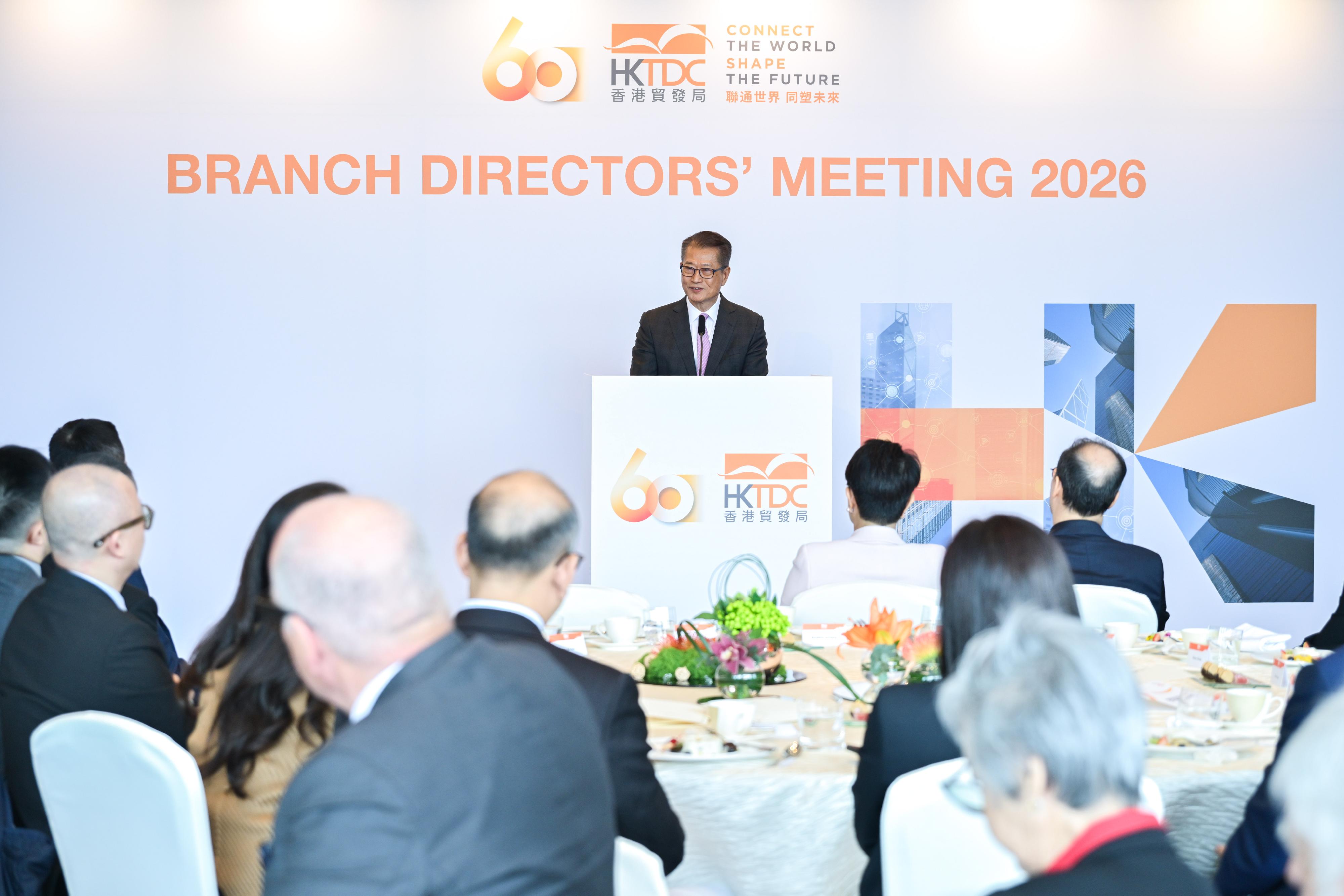

Speech by FS at keynote luncheon of Hong Kong Trade Development Council Branch Directors' Meeting (English only) (with photos)
******************************************************************************************
Sophia (Executive Director of the Hong Kong Trade Development Council, Ms Sophia Chong), colleagues of HKTDC, distinguished guests, ladies and gentlemen,
Good afternoon. Now that dessert has been served, I guess Sophia wanted to make sure you would all be in a good mood before I begin. I am grateful for the strategy.
It is a real pleasure to be with you today. To all Branch Directors and overseas colleagues of the HKTDC: welcome home, after another year of hard work on the front lines around the world.
Many of you have been based overseas for extended periods. I'm sure you can see and feel the shifting currents of the global economic landscape first hand. Intensifying unilateralism, geoeconomic fragmentation, technological disruption and regional conflicts are reshaping the direction, substance and structure of global trade and investment.
As the saying aptly goes: the only certainty is uncertainty.
Clearly, the world is changing. But for those seeking to do business, invest and create value, this is also a world rich in opportunities. One thing can be said with confidence: our country, China, has emerged as a pivotal force for future global growth.
For investors around the world, understanding China's role in the new wave of global development and technological innovation has become an indispensable part of any serious asset allocation strategy.
China's new frontier
The National 15th Five-Year Plan is a remarkable document charting our country's future. Two points are particularly worth noting.
First, it places industrial modernisation and technological self-reliance at its very core. Here, AI holds a special place. It will be a major industry in its own right, but the broader vision is for AI to empower every sector under the "AI+" strategy.
In many frontier technologies, China has moved to the forefront. Add to this its unmatched manufacturing capabilities, the world's most complete supply chains, and one of the most stable electricity supplies anywhere on the planet. Together, these form a formidable foundation for emerging and future industries - from AI to 6G, and from biotech to aerospace. China is set to be an increasingly powerful engine of technological advancement, and a defining voice in shaping rules, standards and governance.
The second point worth noting is the strong emphasis placed on high-level, two-way opening up. But this is not a mere reprise of the past. Reform and opening up since 1978 made China the world's factory, supported in large part by competitive labour costs. That model had already long undergone a fundamental shift.
First, we are seeing what may be called an outbound technology transfer. Companies such as CATL and BYD are building factories in Europe. The trend of Mainland companies, products and technologies going global will only accelerate in the years ahead.
Second, China is building a more powerful consumption market - one that increasingly seeks quality products and services from around the world. The Central Government has made clear that more quality foreign products and services are welcome. After all, China is one of the very few countries in the world that hosts a dedicated import expo every year.
Hong Kong's changing role
I have spent some time on our country's strategic direction because it is inextricably linked to Hong Kong's value proposition as a "super connector" and "super value-adder". Indeed our role is being elevated in a number of ways.
On the merchandise trade front, the sharp rise in Hong Kong's exports over the past year speaks to strengthening intra-regional trade ties, as the Mainland continues to realign its supply chains and industry base across Southeast Asia. ASEAN (Association of Southeast Asian Nations) is our second-largest trading partner.
Digging deeper into headline figures, a more telling story emerges. The prominence of electronic and communications products in our re-exports reflects the world's surging quest for AI-related development. And it also underlines a fundamental reality: for all the talk of supply-chain diversification, the depth, scale and sophistication of China's industrial ecosystem remain indispensable.
In the capital markets, global investors are increasingly attracted by China's technology prospects. That is why they look to Hong Kong to access the stocks of Chinese technology companies, many of which remain attractively valued. And as the use of home currencies in global trade increases, global holders of Renminbi are seeking more investment and risk-management tools. Hong Kong is the natural hub for them. We are rolling out more Renminbi-denominated products, enhancing Renminbi liquidity, and improving the relevant supporting infrastructure.
We have also become a preferred home for technology and innovation enterprises. The reasons are clear. Companies value our ability to bridge the Greater Bay Area with the international market. They value our bilingual and multicultural environment. And they value our international visibility as a platform to showcase products and technologies.
Many international technology companies are eager to establish a presence in Hong Kong. For instance, five of the world's top 10 pharmaceutical companies have set up R&D (research and development) centres in Hong Kong, drawn by the Greater Bay Area's capabilities in clinical collaboration and the cross-boundary data flow.
So if Hong Kong was once valued mainly as a gateway into China, today we are just as important as a launch pad for Chinese enterprises, capital and innovation outcomes to reach the world.
Taken together, these developments point to one unmistakable truth: Hong Kong is no longer simply connecting the dots; we are helping to create the next generation of opportunities. And at this rare moment of global realignment, we cannot afford to miss our chance.
Playing a catalytic role
This is precisely why we position ourselves - the HKSAR (Hong Kong Special Administrative Region) Government - as a capable government serving an efficient market.
Classic Hong Kong has always emphasised a laissez-faire level playing field and favourable environment for businesses to thrive. Today, we also recognise the importance of our catalytic role. We remain champions of the free market and free trade. But there is much more we can do to cocreate Hong Kong's future.
In this year's Budget, we proposed the "Finance+" and "AI+" strategies. The core concept is empowerment.
Through "Finance+", our goal is to broaden and deepen Hong Kong's financing functions as an international financial centre, and to make finance serve the real economy more effectively.
This means strengthening the financing chain for enterprises at different stages of growth - from venture capital and private equity, to listing, bond issuance, wealth management, risk management and cross-boundary capital flows.
It also means using Hong Kong's capital markets to help technology companies scale up; provide trading businesses with better treasury, settlement, insurance and risk-management services; support Mainland enterprises as they go global; and help international companies access the Mainland and Asian markets.
Through "AI+", we will develop AI as an industry, while also accelerating its adoption across the wider economy.
On the one hand, Hong Kong will continue to build the foundations for AI development - including computing power, infrastructure, data, R&D, talent, financing and commercialisation support. On the other hand, we will encourage the application of AI in finance, trade, logistics, professional services, healthcare, education, public administration and many other sectors.
The purpose is not simply to promote a new technology. It is to help enterprises raise productivity, create new business models, help improve public services, and equip our workforce and community for the profound changes that AI will bring.
Today, we launched a public consultation on Hong Kong's own Five-Year Plan. This is an important step in aligning proactively with the National 15th Five-Year Plan, while setting out Hong Kong's own medium- and long-term priorities.
The power of connectivity
Ladies and gentlemen, our vibrant future will not be possible without strong international connections. To capture the opportunities ahead, Hong Kong must continue to widen its global network, deepen its market intelligence, and strengthen its ability to connect people, capital, goods, technology and ideas across borders.
This is where the HKTDC's role is so important. With 51 offices around the world, working alongside our 15 Economic and Trade Offices and other government partners, you are Hong Kong's eyes and ears – as well as ambassadors – in the global marketplace: reading the local mood, identifying emerging opportunities, and building the trust that opens doors.
I would encourage each of you to stay closely attuned to developments on the Mainland and around the world - from shifting supply chains and capital flows, to emerging markets and the transformative impact of AI. At the same time, keep close track of Hong Kong's progress and evolving strengths. The better we understand both the world around us and the city we represent, the more compellingly we can tell Hong Kong's story - and the more effectively we can translate that story into opportunities.
Thank you very much. And now I am happy to take your questions.
Ends/Monday, June 15, 2026
Issued at HKT 14:20
Issued at HKT 14:20
NNNN
Photo