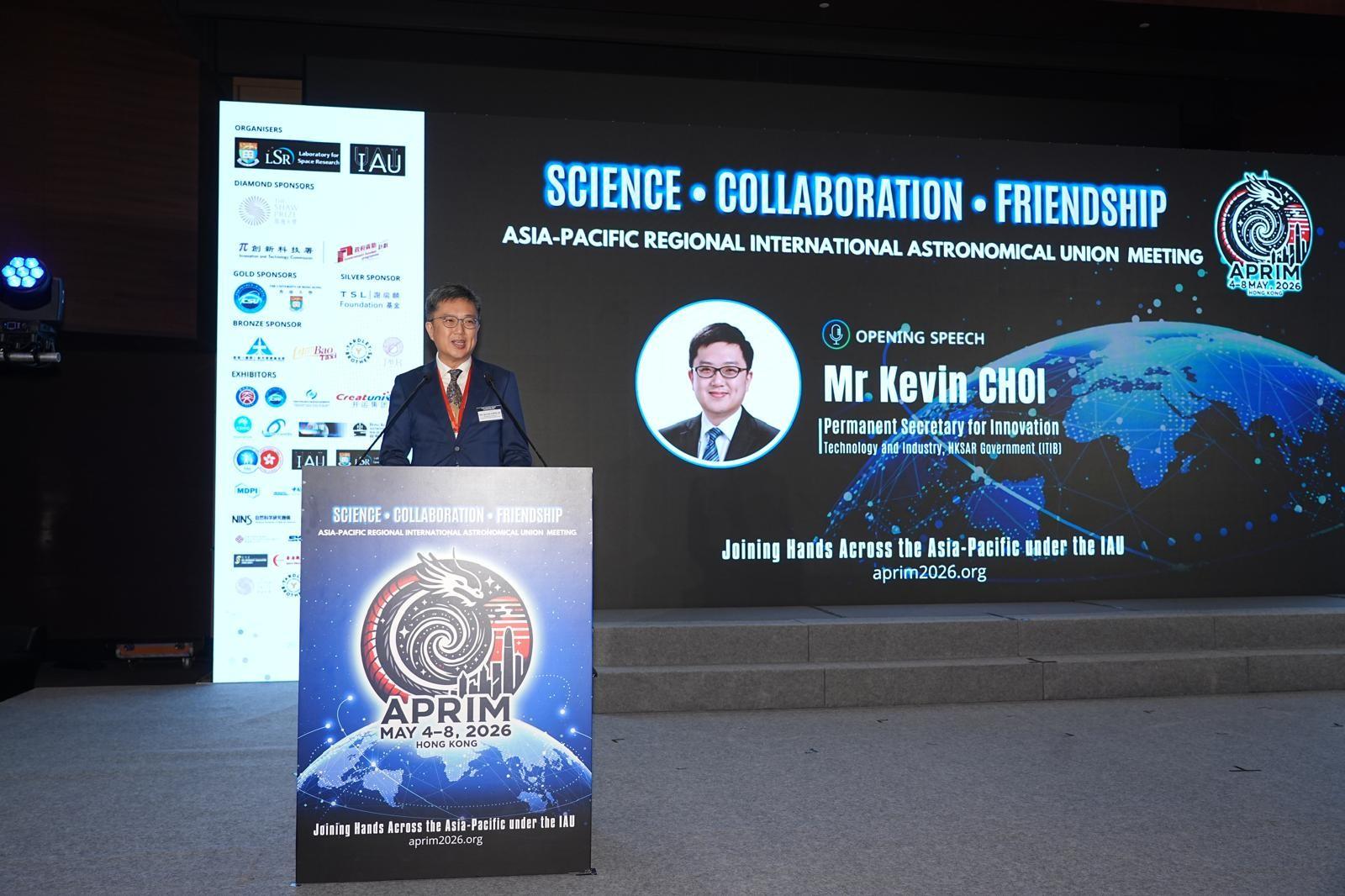

Speech by PSITI at opening ceremony of Asia-Pacific Regional International Astronomical Union Meeting 2026 (English only) (with photo)
******************************************************************************************
Distinguished guests, esteemed scientists and astronomers, ladies and gentlemen,
Good morning. It is a distinct honour to join you today for the opening ceremony of the Asia-Pacific Regional International Astronomical Union Meeting. To our friends who have travelled from across the region and around the globe, a very warm welcome to Hong Kong. And to local scientists and astronomers, I am sure that you are as thrilled as I am to join this star-studded conference here.
When people speak of Hong Kong, they often envision our iconic skyline, our bustling Victoria Harbour, and our status as a premier hub for finance and trade. But today, I have to invite you to look beyond our skyscrapers - all the way to the stars. Hong Kong is not just a spectator in the cosmos. We are determined, well equipped and well positioned to carving out a unique niche in space technology.
Our nation China has set a visionary strategic direction, and it is accelerating the journey towards becoming a global aerospace powerhouse. Under the unique "one country, two systems" principle, Hong Kong stands as the only city in the world that seamlessly integrates the "China advantage" with a distinct "global advantage". In fact, the National 15th Five-Year Plan shows unwavering support for Hong Kong's development into an international innovation and technology (I&T) centre. This makes us the ideal host for this prestigious IAU gathering, among other prominent international scientific conferences.
Our confidence to be the international I&T centre, alongside aerospace developer, is rooted in a bedrock of world-class excellence. Hong Kong is home to five universities ranked among the world's top 100, creating an open and vibrant research ecosystem. The Government is steadfast in its commitment to supporting our scientists in participating in national space mission projects, leveraging our strengths in basic research to solve the mysteries of the universe.
In terms of concrete investment, our Innovation and Technology Support Programme supported by the Innovation and Technology Commission, has launched the Special Call on Aerospace Technology, allocating over $100 million to support six flagship R&D (research and development) projects. This includes pioneering work led by our hosts today, the University of Hong Kong (HKU). We will continue to work hand-in-hand with the academic sector to foster a sustainable and thriving aerospace research environment.
We are also proud of the Hong Kong Space Robotics and Energy Centre (HKSREC), established under the InnoHK research clusters. In collaboration with local universities including HKU and other esteemed partners, the HKSREC is currently developing a multifunctional lunar surface operation robot. This is not a mere academic exercise; this technology will be directly applied to the Chang'e-8 (嫦娥八號) lunar exploration programme, enabling scientific exploration, instrument deployment, and collaborative operations in the moon's challenging environment. Imagine Hong Kong is now on the moon's surface.
Building on this momentum, I am also pleased to share that the newly established SEAM@InnoHK - our third InnoHK research cluster focusing on sustainable development, energy, advanced manufacturing and materials - has admitted eight cutting-edge R&D laboratories. Among them there is the Centre for Space Manufacturing Technology, which will further strengthen Hong Kong's role in advancing aerospace innovation and contribute to the long-term vision of sustainable space exploration, which is one of the key topics of this conference too.
Equally exciting is the participation of an HKU research team in the country's Tianwen-3 (天問三號) planetary mission. The Short-Wavelength Infrared Spectrometer, developed right here at HKU, has been officially selected as a payload for the mission. This instrument will be vital for forecasting Martian dust storms and searching for biosignatures. These achievements underscore the Hong Kong Government's strategic initiative to cultivate a local aerospace industry by leveraging our special, unique geographical and institutional advantages.
Ladies and gentlemen, Hong Kong may be small in landmass, but our scientific ambition is boundless. With robust government backing, world-class talent, and deep cross-boundary synergy, we are not just witnessing the nation's and the world’s space journey - we are helping to engineer its future.
Lastly, may I wish the IAU Asia-Pacific Meeting every success and hope you all have a rewarding exchange of ideas over these few days.
Thank you very much.
Ends/Monday, May 4, 2026
Issued at HKT 12:38
Issued at HKT 12:38
NNNN
Photo