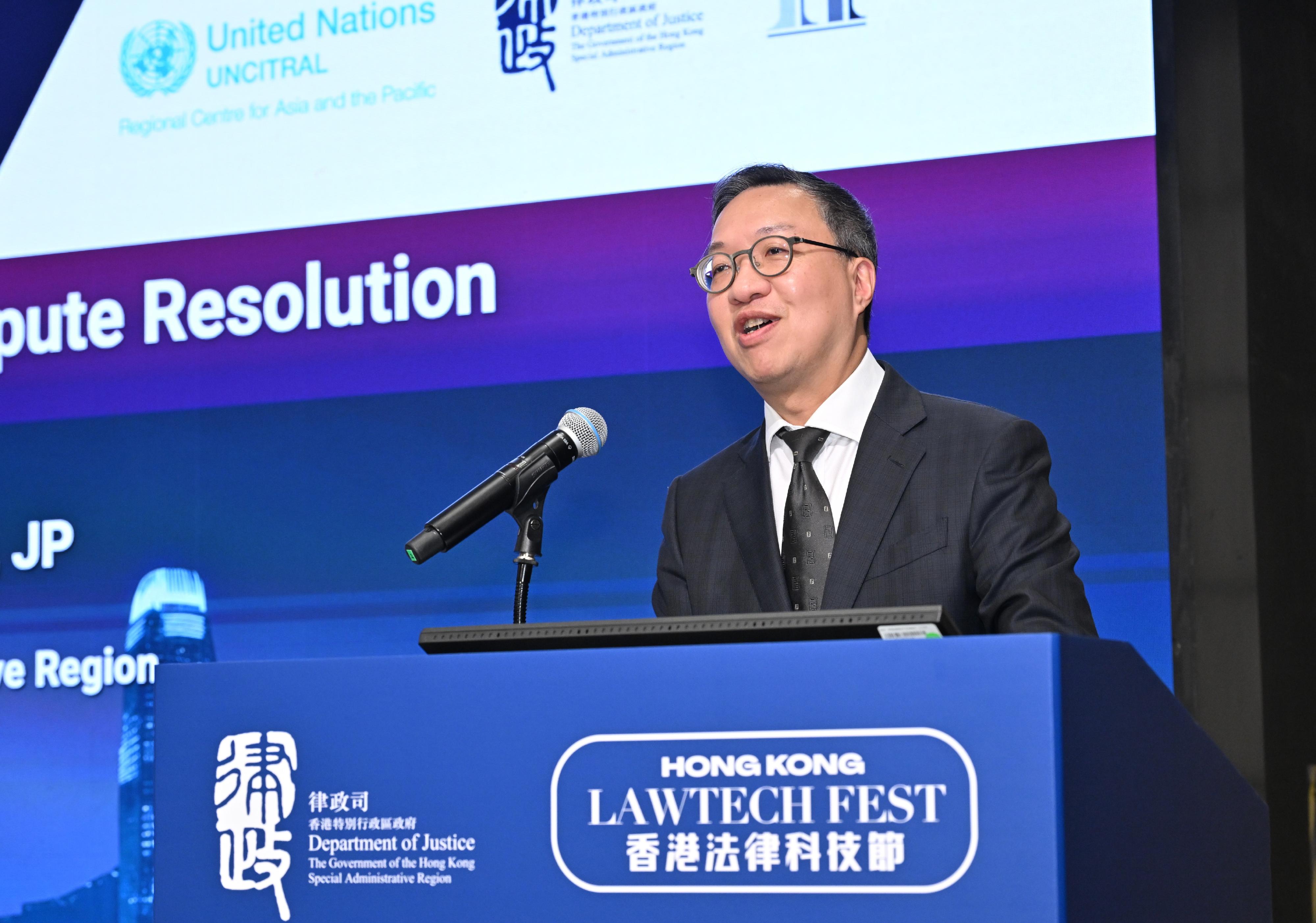

Speech by SJ at 6th UNCITRAL Asia Pacific Judicial Summit 2025 - Judicial Roundtable (English only) (with photo)
******************************************************************************************
Your Excellencies, distinguished judges and guests, ladies and gentlemen,
Today is the second day of the 6th UNCITRAL Asia Pacific Judicial Summit – the Judicial Roundtable, I wish to extend my special thanks to UNCITRAL (United Nations Commission on International Trade Law) for the organisation of the Roundtable and the Asian Development Bank for the Russian simultaneous interpretation so that judges from the Central Asia and other Russian-speaking jurisdictions would be able to participate in the roundtable discussions.
The format of "Roundtable" is to facilitate knowledge sharing and open dialogue under an inclusive environment, which would enable participants to actively engage in the discussion. The theme of the Judicial Roundtable today is "Recent Trends in Dispute Resolution", with two sessions discussing firstly "Judicial Handling of Disputes involving the Use of AI" and second, "Interactions between Alternative Dispute Resolution and Court Proceedings". Let me share with you some of the recent initiatives in Hong Kong in this respect.
Hong Kong has been widely recognised as an international legal and dispute resolution services centre for many years. In the 2025 International Arbitration Survey published by Queen Mary University of London, Hong Kong is ranked the second most preferred seat of arbitration globally, and is the most preferred arbitration seat in the Asia-Pacific region. To further strengthening Hong Kong's edges in international arbitration, the Department of Justice has newly set up a Working Group on Arbitration Law Reform to review and make recommendation to amend our Arbitration Ordinance.
Apart from promotion of arbitration in general, we are promoting arbitration in specialised fields. For instance, it is one of the policy initiatives of the Chief Executive's Policy Address this year to establish a sports dispute resolution system and to promote sports mediation and arbitration, leveraging the institutional advantages of Hong Kong in dispute resolution. The Department of Justice established the Advisory Committee on Sports Dispute Resolution, and would launch a pilot scheme on sports dispute resolution for two years, providing a dedicated mechanism for resolving sports disputes through mediation and dispute resolution.
When it comes to international mediation, the establishment of the International Organization for Mediation (IOMed) provides a platform for settlement of international disputes, which includes disputes between a government and foreign nationals and also international commercial disputes through mediation. With its headquarter situated in Hong Kong, I am sure the establishment of IOMed will not only promote dispute resolution through mediation and other means, but also create synergies with other international organisations, non-governmental organisations and academic institutions, which will further consolidate Hong Kong's status as an international legal and dispute resolution services centre.
Lasty, I would like to mention the use of technology and artificial intelligence in Hong Kong. There is currently no bespoke legislation governing AI in Hong Kong. To harness the potential benefits this new technology may bring, it is incumbent upon the Hong Kong Government to take the lead to review the relevant law so as to provide a facilitative yet properly controlled legal environment for AI's development. As mentioned in this year's Chief Executive's Policy Address, the Department of Justice will form an interdepartmental working group to co-ordinate the responsible bureaux to review the legislation needed to complement the wider application of artificial intelligence.
On this front, we are also promoting the use of lawtech in the Hong Kong legal and dispute resolution industry. Since the establishment of the Consultation Group on LawTech Development early this year, we progressively promote technology in the legal industry by adopting a three-stage approach, with the aim of enhancing the efficiency and quality of professional services through technology. These three stages include first, raising awareness of the legal profession and lawtech education for law students; second, engaging the legal profession with lawtech products through exhibitions and market surveys to enable firms to find suitable solutions for their business growth; and thirdly, encouraging the local and international lawtech enterprises to establish a presence in Hong Kong, in order to foster a vibrant lawtech ecosystem. We will also periodically review the legal framework to ensure it supports and regulates new legal technologies effectively.
To conclude, I would like to thank the moderators, speakers of today's Judicial Roundtable, and all the participants, as well as UNCITRAL for their collaboration with the Hong Kong International Legal Talents Training Academy. The Academy was launched last year which is dedicated to conduct capacity building programmes in diverse areas of law for different stakeholders in the region and beyond. This Judicial Summit co-organised by UNCITRAL and the Academy has become a key platform for capacity building for judges coming from different parts of the world.
On this note, I wish you all a very fruitful and enlightening roundtable discussion. For those who are leaving Hong Kong after the Roundtable, I wish you a safe journey home. For those joining us online, I am very keen on seeing you joining us in person in Hong Kong at the next UNCITRAL Asia Pacific Judicial Summit in 2027. Thank you very much.
Ends/Tuesday, December 2, 2025
Issued at HKT 13:25
Issued at HKT 13:25
NNNN
Photo